




.svg)

.svg)
.svg)

🇺🇸 22 Boston Wharf Rd, Boston, MA 02210
🇬🇧 2 Pear Tree Court, London EC1R 0DS
© 2026, Juro. All rights reserved.


🇺🇸 22 Boston Wharf Rd, Boston, MA 02210
🇬🇧 2 Pear Tree Court, London EC1R 0DS
© 2026, Juro. All rights reserved.

The billable hour has survived recessions, regulatory upheaval, and waves of legal tech developments. But AI poses a different kind of threat by exposing how disconnected time-based billing is from the value clients actually receive.
So is the billable hour finally dying? Or do we simply perceive value differently in the AI era?
The billable hour is a pricing model where law firms charge clients based on time spent working on a matter. One hour worked equals one hour billed, multiplied by the lawyer’s rate. This is also known as ‘time-based billing’.
Over time, the billable hour embedded itself deeply into legal culture. It shaped how lawyers were trained, how performance was measured, and how success was defined. Progression became linked to utilisation. “Hard work” became synonymous with long hours. Efficiency, while valued in theory, was quietly disincentivised in practice.
Clients accepted this arrangement for a long time, largely because it made sense in context. Legal work was manual and labour-intensive. Documents were drafted from scratch. Research meant hours in libraries or databases. In that world, time was a reasonable proxy for effort, and effort felt closely tied to value.

But that historical logic is starting to break down.
The billable hour was designed for a slower, more linear model of legal work — one where thinking and processing were inseparable. Today, technology, and particularly AI, has pulled those two things apart. Much of what once consumed hours of human attention can now be done in minutes.
The expertise still matters, but the mechanics no longer justify the same relationship between time and cost.
Unsurprisingly, our survey data revealed that 45 per cent of in-house lawyers believe that BigLaw offers 'poor' or 'terrible' value for money. And they felt that way for a few reasons:
Despite years of predictions and discontent, the billable hour still dominates Big Law and much of the mid-market. In fact, research repeatedly shows that average hourly rates continue to rise year over year, and the sum of billable hours lawyers are completing follow the same trend.
{{quote1}}
Clearly, the billable hour persists.
But what has changed is client tolerance.
The entry (and subsequent adoption) of AI has made it obvious that:
All of this creates a credibility gap. Clients either know or assume that AI is being used. But their invoices haven't evolved to reflect time saved.
As AI becomes more embedded in legal workflows, a fundamental question keeps resurfacing:
If the same legal outcome is delivered faster, is it worth the same as it was before?
From a law firm’s perspective, the value of the work hasn’t changed. The advice is still correct. The risk is still managed. The responsibility still sits with a qualified lawyer.
In many cases, the firm would argue that value lies in judgment, not keystrokes, and that judgment is just as valuable whether it’s applied quickly or slowly.
From a client’s perspective, the calculation often feels different.
If the same contract is reviewed, the same issues flagged, and the same outcome achieved — but in a fraction of the time — it’s hard to reconcile why the price should remain anchored to a pre-AI world. Especially when the client knows the speed gain wasn’t achieved through extra effort, but through technology.
This isn’t about “discounting expertise.” It’s about recognising that value and cost have historically moved together. And that they don’t always today.
The deeper issue is that the billable hour prices inputs, not outcomes. It assumes that more time equals more value, even when technology has made time largely irrelevant to delivery.
{{quote2}}
That’s why debates about “fair pricing” quickly become philosophical. Is the value of a contract review the peace of mind it delivers? The risk it avoids? The hours it once consumed? Or the fact that it now barely consumes any at all?
There’s no universally accepted answer ... and that’s exactly the problem.
Without a shared definition of value, pricing defaults back to what’s measurable. And time, even when it’s no longer a good proxy, remains the easiest thing to measure.
For clients, this creates a growing sense of misalignment. They aren’t questioning whether lawyers deserve to be paid well. They’re questioning whether yesterday’s pricing logic still makes sense when the work itself has changed so fundamentally.
And for many legal teams, that question becomes a catalyst, not for renegotiating invoices, but for rethinking which work should be outsourced in the first place.
In fact, 19 per cent of respondents in our recent survey replaced outside counsel with AI for a task this past year, and 34 per cent considered doing so within six months.
{{quote3}}
Once legal teams start questioning whether outsourced work still represents fair value, the next step is practical rather than philosophical. If time based billing no longer reflects how work is delivered, the obvious response is to reduce the amount of work that needs to be billed in the first place.
That's where tools like Juro come in.
Rather than focusing on how external counsel bills, Juro helps legal teams decide when external counsel is actually needed. It gives in-house teams the infrastructure to handle contract work that no longer justifies being sent out because it’s now predictable, repeatable, and well understood.
Juro applies AI across the contract lifecycle to handle the parts of legal work that no longer need to be manually repeated. Contracts can be generated from approved templates, reviewed against playbooks, and checked for risk automatically before a lawyer ever becomes involved. Common deviations are flagged instantly, and acceptable fallbacks are applied consistently.
Instead of sending first pass review to external counsel, legal teams can rely on AI to do the initial analysis at scale. Lawyers then step in where judgment is actually required, rather than acting as human processors for routine clauses and redlines.
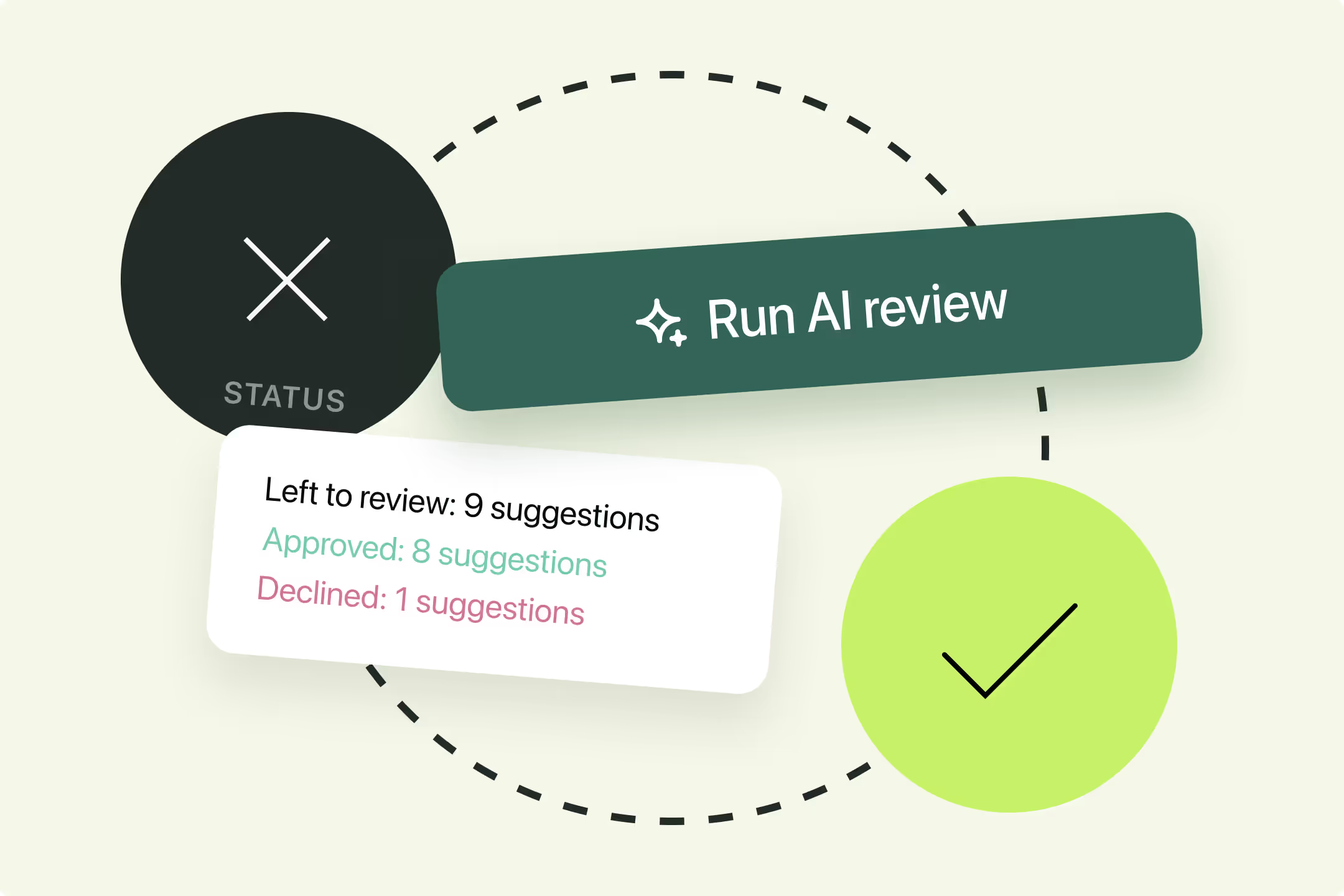
This changes the role of legal inside the business. Contract work becomes faster and more predictable, but also more controlled. Knowledge that once lived in inboxes or individual preferences is captured in the system and reused automatically. The organisation benefits from consistency without sacrificing oversight.
Crucially, Juro’s AI does not aim to replace legal decision making. It removes the mechanical work that used to justify outsourcing. As a result, external counsel becomes a strategic resource rather than a default one.
For legal teams navigating the shift from time based billing to outcome driven work, this is a practical way forward. Not by waiting for the billable hour to disappear, but by using AI to make it less relevant to everyday contract work.
How? By automating routine contract work in-house instead:
{{quote4}}
The most forward-looking legal teams are not waiting for firms to redefine value or redesign pricing models. They are using AI to decide which work leaves the business at all. By automating routine contract work in house, they reduce reliance on time based billing without needing to renegotiate it.
Juro is built for that shift. It gives legal teams the tools to standardise, automate, and scale contract work with confidence, so external counsel is reserved for situations where judgment truly matters.
If you are questioning whether the billable hour still reflects value in an AI era, the next step is not theoretical. It is operational.
Book a demo below to discover how Juro helps legal teams contract faster and reduce external spend.

Lorem ipsum dolor sit amet, consectetur adipiscing elit. Suspendisse varius enim in eros elementum tristique. Duis cursus, mi quis viverra ornare, eros dolor interdum nulla, ut commodo diam libero vitae erat. Aenean faucibus nibh et justo cursus id rutrum lorem imperdiet. Nunc ut sem vitae risus tristique posuere.


Hello. We are Juro Online Limited (known by humans as Juro). Here's a summary of how we protect your data and respect your privacy.





Richard Mabey, CEO at Juro
Richard Mabey, CEO at Juro
Richard Mabey, CEO at Juro
.avif)
Courtney Byrne, Director of Strategic Growth at BB Imaging