AI

The 7 deadly sins of legal AI adoption (and how to avoid them)

January 8, 2026
7
min
January 8, 2026
7
min
Share this article

Content

Agree contracts anywhere

Juro powers 2.5 million contracts for the world’s fastest-growing businesses.
Get a demo
From contract review and knowledge management to predictive analytics and compliance, legal AI promises faster turnaround times, reduced costs, and more strategic work for lawyers.

Key takeaways

  • Legal AI fails without foundations: most unsuccessful implementations aren’t caused by the AI itself, but by poor data, unclear goals, weak integrations, and lack of change management. AI only delivers value when it’s built on clean contracts, structured data, and consistent workflows.
  • AI should augment lawyers, not replace them: the highest-impact use cases focus on repetitive, rules-based work (extraction, playbook checks, summaries), while keeping humans in control of judgment, negotiation, and risk decisions.
  • Measurable ROI and trust drive adoption: legal AI sticks when teams track business outcomes (cycle time, revenue acceleration, cost savings), future-proof their stack, and treat security, privacy, and user buy-in as non-negotiables from day one.

But while the opportunities are significant, the risks are also well-documented. Research from Gartner suggests that up to 85 per cent of AI projects fail to deliver business value. Legal is no exception.

Firms and in-house teams rushing to adopt AI often encounter stumbling blocks — and the fallout can be expensive, time-consuming, and at the expense of future confidence.

That isn’t to say you shouldn’t be adopting legal AI. Our view is that you absolutely should. It’s a competitive advantage, and one teams like yours can’t afford to neglect. But we are saying that you need to give legal AI implementations the love and care they deserve. Otherwise, you risk becoming part of those 85 per cent of failed deployments.

In this article, we’ll examine the seven deadly sins of legal AI adoption. For each, we’ll explore the underlying problem, share examples of how teams fall into the trap, and offer practical steps to ensure your legal AI initiative drives real, measurable value.

1. Chasing hype without a strategy

Legal AI is everywhere. It’s in conference agendas, boardroom conversations, and LinkedIn posts. With so much noise, it’s tempting for legal leaders to buy the first shiny product that promises to fix all of their problems with AI.

The problem is that hype-driven decisions rarely solve the real issues. Tools land in the workflow without a clear use case, and adoption fizzles. By failing to anchor legal AI to tangible business outcomes, legal ends up right back where it started, except with less budget and more skepticism to overcome next time.

How to avoid it:

  • Start with the problem, not the product. Identify bottlenecks in your existing, manual workflows (e.g., slow contract turnaround, manual NDA reviews).
  • Define success upfront. Set measurable goals that tie directly to the solutions to these problems (e.g., reduce contract cycle times by 30%).
  • Test before you scale. Run pilot projects to validate impact before rolling out across the organization.
  • Get into the details. Request more personalized demos of legal AI tools to get a better understanding of how they solve your specific challenges.

In our recent podcast episode, Lucy Bassli, explained this brilliantly:

{{quote1}}

2. Underestimating change management

Even the most powerful AI won’t succeed if humans resist it. Lawyers are trained to be risk-averse, skeptical of black-box outputs, and protective of their methods. Without thoughtful change management, AI adoption can spark backlash, low usage, and wasted investment.

How to avoid it:

  • Engage stakeholders early. Involve lawyers, paralegals, and ops in vendor demos early on in the discovery process to get a better understanding of friction and how to address it. Dumping a new tool on their desk is no way to get buy-in.
  • Communicate the “why.” Instead of focusing exclusively on what the tool is capable of, think about how you frame the why first. If you can’t do that, you’ve fallen at the very first hurdle (the first sin).
  • Invest in training. Provide hands-on workshops and create “AI champions” to lead adoption throughout your organization.
  • Iterate with feedback. Build trust by improving AI workflows based on user input. After all, no effective, sustainable legal AI is truly plug-and-play.

3. Ignoring data quality

AI is only as good as the data you feed it. If your contracts are scattered across inboxes, shared drives, and half-baked PDFs, don’t expect accurate outputs. Poor data undermines trust, and when lawyers don’t trust the tool, they stop using it.

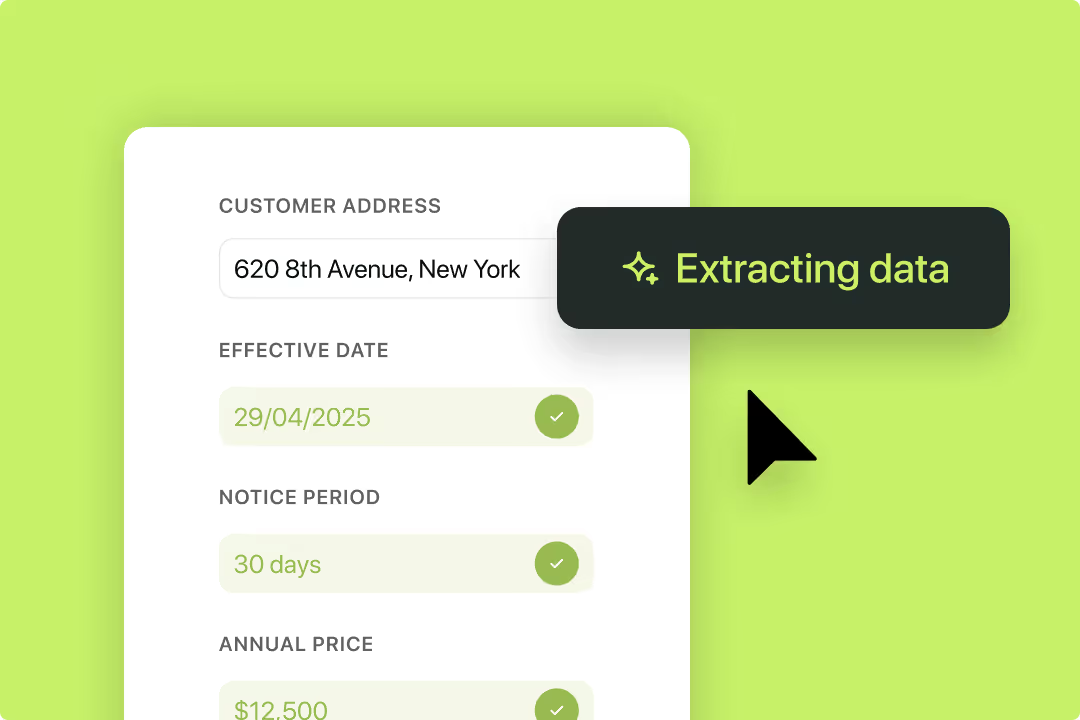
For most legal teams, the real challenge isn’t deploying AI — it’s getting their contract data into a clean, structured state first.
How to avoid it:

  • Centralize contracts. Don’t leave agreements scattered across inboxes, shared drives, or different CLMs. Move everything into one source of truth so that when AI tools query your data, they’re pulling from a single, consistent repository.
  • Standardize inputs. Decide which contract metadata matters most — renewal dates, counterparties, values, governing law, etc. — and ensure it’s always captured in the same format.
  • Start with clean data. Don’t try to boil the ocean. Pick one contract type (like NDAs or MSAs), clean that dataset thoroughly, and run your first AI pilots there. Once you’ve validated outputs and built confidence, then expand to broader categories.
  • Maintain hygiene. Data quality isn’t a one-time clean-up — it’s an ongoing process. Schedule quarterly or biannual audits to spot duplicates, fill missing metadata, and archive outdated templates as you grow.

With Juro, you don’t have to wrestle your contracts into structure manually. Every agreement created and managed in Juro is stored as structured data from day one, and with AI Extract, key fields and dates are captured automatically. That means consistent, searchable, and trackable contract data — without hours lost to manual clean-up.

Hit the button below to see Juro’s AI extract functionality in action.

They put contracts on autopilot. You can too.

Whether it’s your CRM, communication platform, AI Assistant, or somewhere more exotic, Juro enables contracting to happen anywhere - right where your colleagues already work.
Get a demo

4. Skipping ROI measurement

Too many AI initiatives stop at implementation. The tool is live, but nobody tracks whether it’s delivering real value. When budgets tighten, these unmeasured projects are the first to go. That’s why ROI can’t be an afterthought.

For AI to stick, legal teams need to show how it impacts the metrics the business actually cares about: faster revenue recognition, lower outside counsel spend, and fewer contracts slipping through unnoticed.

How to avoid it:

  • Set KPIs upfront. Don’t wait until after rollout to figure out what success looks like. Align with leadership on the outcomes that matter most before you buy: reduced contract cycle times, lower outside counsel spend, faster approval workflows, or better renewal management.
  • Establish a baseline. Capture current performance metrics before introducing AI: average cycle time by contract type, how many approvals require escalation, average hours spent on manual reporting, etc.
  • Monitor continuously. Measuring ROI once isn’t enough — adoption is an ongoing process. Use dashboards, contract analytics, or BI tools like Power BI or Looker to track progress automatically.
  • Translate for the business. Legal department metrics only resonate if they tie back to commercial impact. Instead of reporting that “contract cycle time fell by 40% per cent,” frame it as “sales closed deals three weeks faster, accelerating revenue recognition by millions of dollars.”

But whatever you do, be realistic about when ROI will become apparent. While some tools deliver significantly faster implementation than legacy CLM vendors, these workflows still deliver incremental value over time, and to measure ROI reliably, you need to factor this continuous upside into the equation.

As Stephanie Corey, Legal Ops expert, shares:

{{quote2}}

5. Failing to futureproof and integrate

The legal AI market is evolving at breakneck speed. Tools that can’t scale or integrate with your broader tech stack risk becoming obsolete within a year, and you’ll be back to square one, except this time fighting for budget that’s locked into costly contracts with point solutions that no longer deliver the promised value.

The cost of switching tools — retraining staff, migrating data, rebuilding workflows — can be enormous. Future-proofing decisions today saves huge headaches tomorrow.

For example, imagine that a legal team chooses an AI tool that doesn’t integrate with Salesforce or Slack, despite these systems being the source of truth for their organization. Within 18 months, adoption collapses because the tool doesn’t fit how the business works, or it causes too much disruption.

Oftentimes, evaluating legal AI solutions is actually about going back to basics and understanding which foundations are needed for the AI element to excel. Integrations are a huge piece of the puzzle.

How to avoid it:

  • Think ecosystem, not silos. Favor tools with APIs and integrations. For example, Juro connects with Salesforce, HubSpot, Slack, and more to embed AI into the workflows you already (and will continue to) use day-to-day.
  • Ask about roadmaps. How will the vendor keep pace with AI innovation in the future? How flexible is their solution, and can it solve more of your problems in the months and years to come?
  • Plan for growth. Can the tool handle more jurisdictions, more contracts, more complexity when you invest more time into building out your workflows? Does it work for other teams, too?

6. Making security and privacy an afterthought

Contracts hold some of the most sensitive information a business has: pricing models, liability terms, customer details, employee agreements, and confidential IP. When you push this information through an AI tool, you’re trusting the vendor with data you simply cannot afford to compromise.

If you fail to scrutinize how AI tools handle that data, the risks are enormous. A vendor without robust controls could mishandle storage, transmit data through unsecured channels, or even use your contracts to train their models without consent. The fallout could include regulatory penalties, reputational damage, and a serious loss of trust from customers and counterparties.

That’s why security can’t be an afterthought — it has to be the very first conversation you have with any AI vendor.

How to avoid it:

  • Vet vendors thoroughly. Treat security certifications as non-negotiables. Look for SOC 2 Type II, ISO 27001, and GDPR compliance at a minimum. These standards demonstrate that the vendor has formalized processes for safeguarding sensitive data.
  • Ask tough questions. Don’t settle for a vague “yes, we’re secure.” Press for details. Where is your data stored? How is it encrypted at rest and in transit? Who within the vendor organization has access to it? Can you delete or export data on demand?
  • Review vendor security materials. The best providers publish detailed trust resources so you don’t have to take them at their word. Juro’s Trust Center is a good example, showing how security, privacy, and compliance are handled in practice.

7. Expecting AI to replace lawyers

AI is powerful, but it isn’t a lawyer. It can speed up repetitive work — flagging risky clauses, checking contracts against playbooks, extracting key terms — but it can’t negotiate with counterparties, interpret ambiguity, or weigh commercial risk.

The problem comes when teams buy into “lawyer in a box” marketing and expect automation to handle judgment-heavy work. Inevitably, the tool underdelivers, confidence erodes, and adoption collapses.

The legal teams who succeed are the ones who frame AI as an assistant. It takes on the heavy lifting, while humans stay in control of decisions. That balance builds trust and ensures adoption lasts.

How to avoid it:

  • Target repetitive tasks. Focus AI on admin-heavy, rule-based workflows: clause extraction, playbook checks, contract summaries, and routine redlines. These are the areas where speed gains are immediate and accuracy is measurable.
  • Keep humans in the loop. Position AI as a co-pilot. Let it suggest edits or highlight risks, but keep final approval with a lawyer. This ensures quality while building confidence in the system.
  • Set expectations clearly. Align stakeholders — from execs to business users — on what AI will deliver (faster admin, quicker reviews) and what it won’t (complex negotiation strategy). Setting realistic expectations up front avoids disappointment later.
  • Redirect time saved. Don’t let freed capacity evaporate into more admin. Reinvest it into strategic, judgment-heavy work: negotiation strategy, risk analysis, and business partnering. AI buys time — legal leaders decide how to spend it wisely.

Where to go from here…

Avoiding the seven deadly sins of legal AI adoption isn’t only about avoiding bad habits — it’s about building on the right foundation. AI is only as effective as the system it runs on. If your contracts are scattered, your processes inconsistent, and your data unstructured, even the smartest AI won’t deliver value.

That’s why legal teams who succeed with AI don’t start with AI. They start with a contract lifecycle management (CLM) platform that gives them control over their contracts, data, and workflows — then layer AI on top to accelerate what already works.

Juro is that foundation:

  • Juro is an intelligent contract platform that delivers value end-to-end — creation, negotiation, eSignature, storage, and reporting in one platform, with AI layered in to make every stage faster and smarter.
  • Every contract created and managed in Juro is stored as structured data, giving AI a reliable foundation. That means outputs are consistent, accurate, and actually useful.
  • From playbook-driven redlines to automated clause checks, Juro’s AI accelerates legal work without removing human judgment.
  • Built-in dashboards track cycle times, approval bottlenecks, and renewal outcomes, so you can show leadership exactly how AI is delivering value.

{{quote3}}

With Juro, legal teams aren’t gambling on hype-driven point solutions. They’re adopting AI with confidence — embedded into their contracting workflows, powered by clean data, and tied directly to business outcomes.

Book a demo below to discover how forward-thinking legal teams are embedding AI into their contracting foundations with Juro.

About the author

Sofia Tyson is the Senior Content Manager at Juro, where she has spent years as a legal content strategist and writer, specializing in legal tech and contract management.

Sofia has a Bachelor of Laws (LLB) from the University of Leeds School of Law where she studied the intersection of law and technology in detail and received the Hughes Discretionary Award for outstanding performance. Following her degree, Sofia's legal research on GDPR consent requirements was published in established law journals and hosted on HeinOnline, and she has spent the last five years researching and writing about contract processes and technology.

Before joining Juro, Sofia gained hands-on experience through short work placements at leading international law firms, including Allen & Overy. She also completed the Sutton Trust’s Pathways to Law and Pathways to Law Plus programs over the course of five years, building a deep understanding of the legal landscape and completing pro-bono legal volunteering.

Sofia is passionate about making the legal profession more accessible, and she has appeared in several publications discussing alternative legal careers.

Read more >

Agree contracts anywhere

Juro powers 2.5 million contracts for the world’s fastest-growing businesses.
Get a demo

Frequently Asked Questions

Lorem ipsum dolor sit amet

Lorem ipsum dolor sit amet, consectetur adipiscing elit. Suspendisse varius enim in eros elementum tristique. Duis cursus, mi quis viverra ornare, eros dolor interdum nulla, ut commodo diam libero vitae erat. Aenean faucibus nibh et justo cursus id rutrum lorem imperdiet. Nunc ut sem vitae risus tristique posuere.

Your privacy at a glance

Hello. We are Juro Online Limited (known by humans as Juro). Here's a summary of how we protect your data and respect your privacy.

Read the full policy
(no legalese, we promise)

Intelligent contracting is here.

Juro embeds contracting in the tools business teams use every day, so they can agree and manage contracts end-to-end - while legal stays in control.
Book my demo
This is some text inside of a div block.

Heading

Heading

Heading

Heading

Heading

Get a demo