





.svg)

.svg)
.svg)

🇺🇸 22 Boston Wharf Rd, Boston, MA 02210
🇬🇧 2 Pear Tree Court, London EC1R 0DS
© 2026, Juro. All rights reserved.


🇺🇸 22 Boston Wharf Rd, Boston, MA 02210
🇬🇧 2 Pear Tree Court, London EC1R 0DS
© 2026, Juro. All rights reserved.

As legal teams take on more volume, more stakeholders, and more risk, contracts are taking longer to move from request to signature. Deals stall. Internal teams grow frustrated. Legal is pulled deeper into day to day contracting work, often at the expense of higher value initiatives.
But long contract cycles are not inevitable. In most cases, they are the result of fragmented processes, unclear ownership, and manual workflows that have not kept pace with the business.
This guide breaks down what contract cycle time really is, why it matters, how to measure it properly, and the practical steps legal teams can take to shorten it without increasing risk.
Contract cycle time is the total time it takes for a contract to move from initial request to signature.
In practice, that journey includes multiple stages: intake, drafting, internal review, negotiation, approval, and execution. The problem is that most teams only look at the start and the end. They measure “request to signature” and miss where time is actually being lost in between.
To shorten contract cycle time, you need to understand which stage is doing the damage first. And to invest resources into shortening it, you need to understand why it matters. Let’s start there.
A long contract cycle doesn’t just delay deals, it’s a clear symptom of legal inefficiency, and the consequences are hard to ignore:
Revenue recognition slips because work can’t begin until contracts are signed. Sales teams lose patience and start bypassing legal, reusing old language or improvising terms to hit targets. Over time, trust erodes: business partners begin to see legal as a bottleneck, not an enabler.
The damage cuts both ways. Faced with growing risk and inconsistency, legal teams respond by tightening control, pulling self-serve contracting off the table and absorbing more work, even when their calendars don’t allow for it. What started as a speed problem becomes a trust problem, and cycle times stretch even further.
Finance will want to cover their ears, too. Businesses lose $122 for every hour an in-house lawyer spends working on a contract, based on salary estimations. Plus, the time spent on contracting is on the rise for many teams, with research by FTI Consulting revealing that 47 per cent of the general counsels they surveyed were experiencing an increase in contract management demands.
It isn’t long before these contract-specific problems become business problems.
Contract cycle time is a shared responsibility, but it needs a clear owner.
Legal typically owns the framework. That includes templates, playbooks, approval rules, and risk guardrails. The business owns the quality of inputs, such as providing complete information and working within agreed standards. Leadership owns prioritization and enforcement when tradeoffs are required.
When no one owns cycle time explicitly, it becomes everyone’s problem and no one’s metric.
That’s why contract cycle periods often fall under legal department KPIs, like most contract lifecycle management metrics.
You can’t shorten contract cycle time unless you know where time is actually being lost.
Many teams say their cycle time is “around a month,” but that headline number hides the real problem. To improve performance, you need to measure contract cycle time by stage, not just end to end.
Here’s what we’d suggest:
Contract cycle time should be measured from the moment a contract is formally requested to the moment it is fully signed and executable.
Avoid starting the clock at “first draft sent.” That skips the intake bottlenecks that often cause the longest delays.
The most useful insight comes from splitting the journey into consistent stages. For example:
This allows you to see whether delays are caused by missing information, approvals, negotiation, or signatures, rather than guessing.
We have an in-depth guide to contract lifecycle stages if you’re looking for somewhere to start.
Average cycle time tells you how you perform on a typical contract. Outliers tell you where your process breaks.
Track:
Outliers are where the biggest improvements usually sit, and they’re a great way to identify the weakest links in your contract process, whether that’s access to tooling, communication failures, or unowned categories of contracts.
Cycle time varies wildly depending on context. If you don’t segment, your data won’t be actionable.
At a minimum, measure cycle time by:
This quickly shows, for example, whether third-party paper is adding weeks — or whether internal approvals are the real issue.
Not all contract time is equal. When reviewing your data, separate:
Most teams discover that waiting time accounts for the majority of their cycle time. That’s good news, though. Waiting time is the easiest to remove.
Once you’ve measured current performance, you have the data you need to set realistic targets for contract turnaround.
These targets give the business clarity and give legal teams a concrete benchmark to improve against. The better your tech stack (e.g if you have a tool like Juro in place), the more aggressive your realistic baseline can be.

Start where your contracts do: the handover. This is often referred to as the intake process or legal front door.
The truth is that many delays occur before legal has even touched the contract:
Requests arrive without enough context. Commercial terms are half agreed. Deadlines are implied rather than stated. Legal then has to pause to clarify scope before any real work can begin.
The most obvious and effective fix here is to standardize contract intake, whether that’s through something basic like a contract request form, or something more sophisticated, like an integration with a CRM to automate contracts when deals cross the line.
This shortens contract cycle length by ensuring every contract starts with enough information to progress immediately. You should enforce a single intake route and make key fields mandatory, including contract type, value, jurisdiction, counterparty, and target signature date. Anything that you need to populate the contract should be provided upfront.
Teams that do this well often remove days of delay without changing anything else.
Just look how easy contract intake and generation becomes when you connect a contracting platform like Juro with a CRM like Salesforce:
Drafting is rarely the biggest problem, but it becomes one when too many versions of the same contract or template exist.
When every deal starts from a slightly different template, variation creeps in. That variation then has to be reviewed, negotiated, and approved. What feels like flexibility at the start creates drag later on.
High-performing legal teams simplify aggressively. They maintain a small set of standard templates that cover most use cases, supported by approved clause alternatives for common deviations. The aim is not to eliminate negotiation, but to make most contracts predictable from the outset.
That’s precisely what Placemakr did via Juro:
{{quote1}}
When drafting becomes a repeatable process, cycle time drops naturally.
Negotiation slows down most when nobody is sure what they are allowed to agree to.
Without clear fallback positions, every redline becomes a question that lands on legal’s desk. That question triggers an internal discussion. The discussion delays the deal.
Teams that shorten cycle time invest time upfront in documenting their positions on the clauses that cause the most friction. Liability caps, payment terms, termination rights, data protection, and IP almost always top the list.
Once these positions are agreed and shared, negotiators can resolve routine points without escalation. Contracts move forward instead of pausing for permission every time.
We recommend setting up a contract playbook and automating it wherever possible. Some forward-thinking businesses are even using AI to negotiate contracts using guardrails they’ve curated.
Approvals are one of the most underestimated causes of long cycle times.
In many organizations, approval requests get buried in inboxes. There is no clear owner, no agreed timeline, and no visibility. Contracts sit idle while people are busy or unsure whether they need to respond at all.
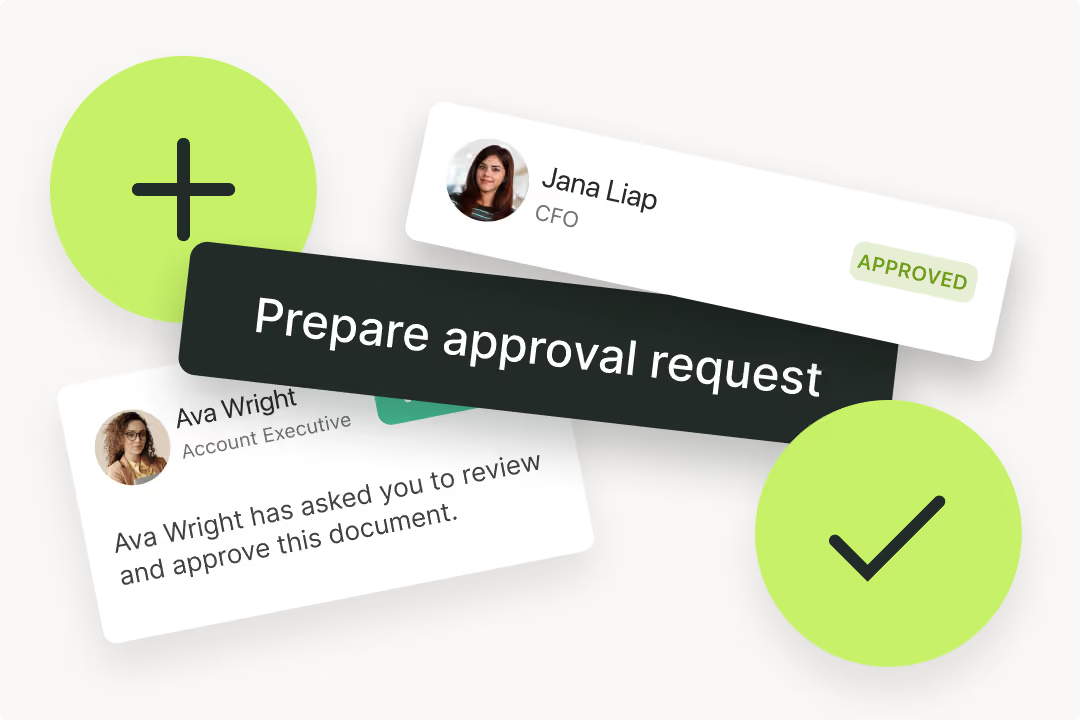
Shortening cycle time means moving away from this model. Instead, you should define clear rules for when approvals are required and route contracts automatically based on value or risk. Then, attach time expectations to each approval so it is clear when action is needed. This can be tackled through automated approval workflows.
When approvals are predictable and time bound, contracts stop disappearing into a black hole.
Email is still the default negotiation tool for many teams, but it silently adds days to the process.
Multiple attachments circulate. Comments get missed. Someone works on the wrong version. Time is lost simply figuring out where things stand. Who even knows if the right document gets signed?!
Teams that move faster in 2026 bring negotiation into a single shared workspace. There is one live document, a clear record of changes, and a visible next step. This reduces friction for both sides and helps maintain momentum through negotiation.
The math here is pretty simple: fewer versions = fewer delays.
By this point, one thing should be clear. Long contract cycle times are rarely caused by slow lawyers or difficult counterparties. They are the result of fragmented systems, unclear ownership, and processes that were never designed to scale.
Shortening contract cycle time requires more than isolated fixes. Intake, drafting, negotiation, approvals, and execution all need to work as a single, connected flow. When those stages live in different tools, inboxes, and spreadsheets, friction is inevitable.
This is exactly the problem Juro was built to solve.
Juro brings the entire contract lifecycle into one platform, from structured intake and automated document generation to collaborative negotiation, approval workflows, and eSignature. Contracts no longer disappear into inboxes or stall waiting for context. Every stage is visible, owned, and measurable.
Teams using Juro shorten contract cycle time by standardizing templates, enforcing clear approval logic, negotiating in one shared workspace, and removing manual handoffs that slow deals down. The result is faster turnaround, fewer escalations, and contracts that actually keep pace with the business.
If your contracts are still stuck in email threads and Word attachments, it is probably time to rethink the infrastructure behind them.
See how Juro helps legal teams shorten contract cycle time and move faster without increasing risk.
Lorem ipsum dolor sit amet, consectetur adipiscing elit. Suspendisse varius enim in eros elementum tristique. Duis cursus, mi quis viverra ornare, eros dolor interdum nulla, ut commodo diam libero vitae erat. Aenean faucibus nibh et justo cursus id rutrum lorem imperdiet. Nunc ut sem vitae risus tristique posuere.


Hello. We are Juro Online Limited (known by humans as Juro). Here's a summary of how we protect your data and respect your privacy.





Davis Troutman, Product Product Manager at Placemakr