.svg)

.svg)
.svg)

🇺🇸 22 Boston Wharf Rd, Boston, MA 02210
🇬🇧 2 Pear Tree Court, London EC1R 0DS
© 2026, Juro. All rights reserved.


🇺🇸 22 Boston Wharf Rd, Boston, MA 02210
🇬🇧 2 Pear Tree Court, London EC1R 0DS
© 2026, Juro. All rights reserved.

Unlock the full potential of your business partnerships with our comprehensive exclusive agency agreement template.


This ready-to-use template is designed to help businesses establish clear terms and conditions for exclusive representation, ensuring that both parties can focus on achieving their goals without any legal ambiguities.
An exclusive agency agreement is a contract between a principal and an agent that grants the agent sole rights to represent, sell, or market the principal's products or services within a defined territory or market segment.
In exchange for that exclusivity, the agent is expected to commit fully to the relationship, typically to the exclusion of competing principals.
The key word is "exclusive." Unlike a standard agency agreement, which may allow the principal to appoint multiple agents in the same space, an exclusive arrangement concentrates all sales activity through a single representative.
That creates real leverage for both sides, but it also raises the stakes on how well the contract is drafted. If the scope of exclusivity, performance expectations, and exit conditions aren't precise, this type of agreement can generate more disputes than it prevents.

It's worth understanding the distinction between exclusive agency and sole agency, which are sometimes used interchangeably but mean different things:
The choice between the two depends on how much commercial freedom the principal wants to retain.
For more background on how exclusivity operates across different contract types, see Juro's guide to exclusive contracts.
Exclusive agency agreements come up across a wide range of industries and commercial contexts. Some of the most common include:
Expanding into new markets. When a business is entering a new geography without an existing sales presence, engaging an exclusive agent with local relationships and market knowledge is often more practical than building a team from scratch. The exclusivity gives the agent the confidence to invest in that market without fear of being undercut by a competing agent appointed by the same principal.
Product distribution and manufacturing. Manufacturers frequently appoint exclusive agents to represent their products in specific regions, particularly in international trade. The exclusive arrangement incentivizes the agent to build brand awareness and develop customer relationships over the long term.
Real estate. In residential and commercial property, exclusive agency agreements are standard practice. An owner lists their property with a single agent for a fixed term, and the agent takes on the cost of marketing and finding buyers in exchange for commission rights. The real estate agency agreement is one of the most commonly used variants of this structure.
Sales representation. B2B companies appointing regional sales representatives often use exclusive agency structures to protect territory integrity and avoid channel conflict.
The elements that matter most in an exclusive agency agreement are those that define the boundaries of the relationship and the consequences when things don't go to plan. A well-drafted agreement should cover:
Full legal names and addresses of both the principal and the agent, with a clear description of each party's responsibilities.
It should be explicit that the agent is acting as an independent contractor, not an employee, unless the arrangement intends otherwise.
Precisely what products or services the exclusivity covers, the geographic territory or market segment in which the agent holds exclusive rights, and whether the principal retains any right to sell directly. Ambiguity here is the most common source of disputes.
The start and end date of the exclusivity period, and the conditions under which it can be renewed or extended. Exclusivity granted for too long without performance milestones can lock the principal into a relationship that isn't generating results. Read more about structuring contract renewal terms effectively.
Specific, measurable targets the agent is expected to meet, such as minimum sales volumes, activity thresholds, or market coverage commitments.
Without these, a principal has little contractual basis to exit a relationship where the agent is underperforming but technically still in place.
Commission rates, the basis on which commission is calculated (gross sales, net revenue, etc.), payment timing, and how commissions are handled for sales that are in progress when the agreement ends. This section requires particular care where the agent has long sales cycles.
More on this in our guide to compensation agreements (plus a free template).
The agent will often have access to pricing, customer data, and brand assets. The agreement should specify what can be used, how, and for what purpose.
The circumstances under which either party can end the agreement, the required notice periods, and what happens to pending deals and commission claims on termination.
Termination for cause versus termination for convenience should both be addressed. Juro's guides to contract termination and termination clauses are useful starting points for thinking through this section.
Particularly important where the parties are in different states or jurisdictions. Specifying which law governs the agreement and whether disputes go to court, mediation, or arbitration avoids procedural arguments if a dispute arises.
Granting exclusivity over an entire country or product category without meaningful performance obligations can effectively lock the principal out of an active sales strategy while giving the agent no incentive to perform. Tie exclusivity tightly to scope and performance from the start.
Post-termination obligations are often neglected completely. But what happens to clients the agent introduced during the term? Are there ongoing commission rights on deals that were in negotiation when the agreement ended? Who owns the customer relationships and data?
These questions need clear answers in the agreement itself, not in a later negotiation when the relationship has broken down.
Exclusive agency agreements typically establish independent contractor relationships, but the practical reality of the working relationship can start to look like employment over time, particularly if the principal exercises close control over how the agent works.
In some jurisdictions, this creates legal risk around employment rights and tax obligations that weren't anticipated when the contract was signed.
Setting targets that are unmeasurable or subjective makes the agreement difficult to enforce and harder to use as a basis for termination if the agent isn't performing. Targets should be specific, time-bound, and agreed by both parties.
If exclusivity is the core commercial deal here, it often makes sense to back it up with appropriate post-termination restrictions. These need to be proportionate and jurisdiction-specific to be enforceable, but the alternative of having no restrictions at all can leave the principal exposed.

Exclusive agency agreements are negotiated contracts, and agents will push back on specific terms. These are the four points where positions tend to diverge.
For businesses operating across multiple regions or product lines, exclusive agency agreements can accumulate quickly. Each agreement carries its own territory, its own performance calendar, and its own commission structure.
Tracking those obligations manually, across email chains and spreadsheet logs, is where things start to go wrong.
The most common operational problems are missed renewal windows, untracked territory overlaps when a new agent is being onboarded in an adjacent market, and commission disputes where payment terms weren't stored accessibly after post-signature. All of these are contract data problems as much as legal ones.
Juro's contract management platform lets legal and commercial teams build exclusive agency agreement templates with structured data fields capturing territory, duration, commission rates, and renewal dates from the point of creation.
Those fields are searchable and reportable, so the business can see at a glance which agreements are approaching renewal, which agents hold exclusivity over which markets, and where conflicts might be emerging.
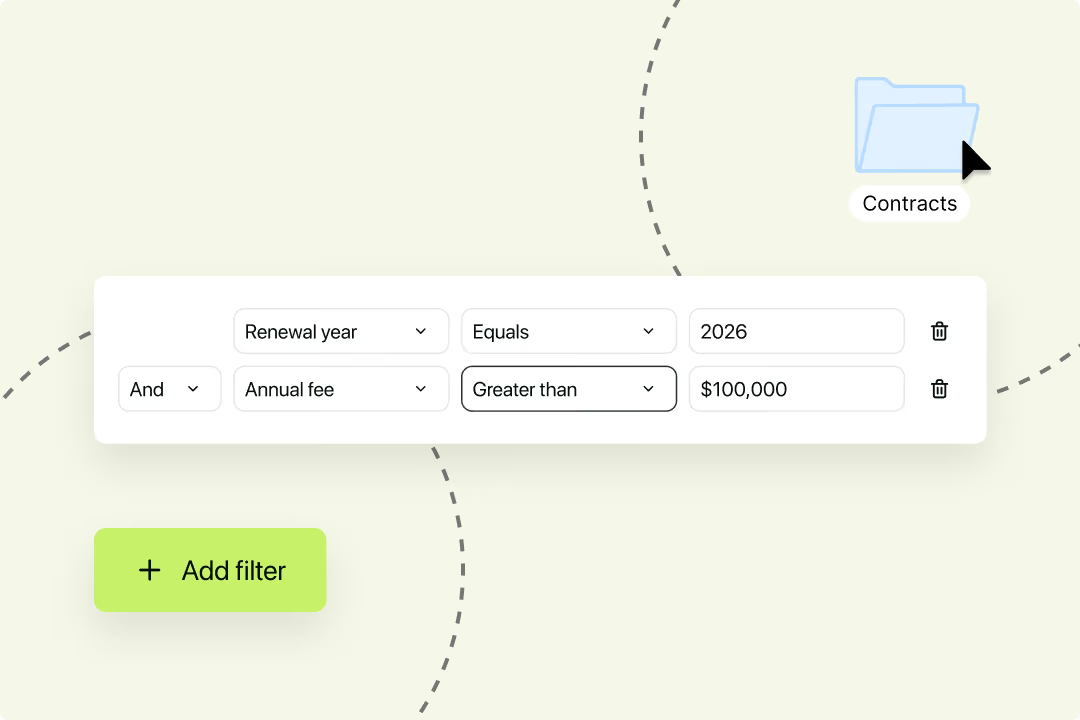
For teams agreeing a high volume of agency contracts, that visibility is the difference between managing a distribution network and being managed by it.
If you're ready to bring your agency agreement process into one place, book a demo to see how Juro handles it, or join the community to hear how other legal and commercial teams structure and manage their agent networks.

Juro is the #1-rated contract platform globally for speed of implementation.


Hello. We are Juro Online Limited (known by humans as Juro). Here's a summary of how we protect your data and respect your privacy.