




.svg)

.svg)
.svg)

🇺🇸 22 Boston Wharf Rd, Boston, MA 02210
🇬🇧 2 Pear Tree Court, London EC1R 0DS
© 2026, Juro. All rights reserved.


🇺🇸 22 Boston Wharf Rd, Boston, MA 02210
🇬🇧 2 Pear Tree Court, London EC1R 0DS
© 2026, Juro. All rights reserved.

As demand for legal input grows, so does the challenge of managing inbound requests efficiently. Without the right processes in place, legal becomes a bottleneck, slowing down deals and frustrating teams across the business.
That’s where a legal front door comes in.
A legal front door acts as a single, structured entry point for legal requests, helping businesses streamline intake, triage work, and respond faster.
Instead of legal requests arriving through a combination of buried emails, Slack messages, or ad hoc conversations, they’re funneled into one clear, trackable system. This not only makes legal teams more efficient but also improves collaboration with commercial teams.
A legal front door centralizes and streamlines legal requests, ensuring they are properly submitted, tracked, and resolved. Instead of legal teams receiving ad hoc requests through emails, Slack messages, or verbal conversations, all requests flow through a structured intake system.
Here’s how it works in practice:
Without a structured intake process, legal requests can become chaotic.
Business teams often don’t know where to go or who to ask for legal help, leading to delays, lost requests, and duplicated work. Meanwhile, legal teams struggle with unclear priorities and limited visibility into their workload.
In fact, our recent survey of in-house lawyers found that 58 per cent of respondents found a lack of budget and resource to be their biggest challenge. This was followed by the 52 per cent that cited feeling buried in low-value work as their greatest concern.
A legal front door solves these problems by providing:
{{quote1}}
For a legal front door to work, it needs to be easy for business teams to use and simple for legal teams to manage. More specifically, you need to do the following things:
The first step is creating a clear, accessible way for business teams to submit legal requests. This could be a dedicated email alias, a structured form in a legal ticketing system, or an integrated request workflow in a contract management platform.
When deciding what that looks like, step back and observe where your teams are already working, and how you can minimize context switching as much as possible. If your teams spend most of their time in Slack or Teams, build a legal front door that meets them there.
{{quote2}}
At Juro, we make this easier than ever. Juro embeds AI contract automation in the tools business teams already use, so they can agree and manage contracts end-to-end - while legal stays in control.
For example, you can integrate Juro with a CRM like Salesforce, HubSpot or Pipedrive and enable commercial teams to self-serve on contract creation from there in just a few clicks.
Similarly, if you want to enable the entire business to generate contracts without jumping into a CLM, you can integrate Juro and Slack instead.
The truth is, not every legal request needs full and manual review. Not if legal can control the terms being agreed in the first place. Just ask Funnel.
When Funnel came to Juro, it was taking fifteen manual steps to agree a single contract, and the legal team needed to review 100 per cent of customer contracts. After implementing Juro, that number dropped to 12 per cent.
How? Well, Juro enabled Funnel to automate a lot of the contract workflow that invites risk when carried out manually.
The legal team can lock contract fields, standardize contract templates, and set advanced approval workflows for contracts that do deviate from the agreed terms.
By integrating automated workflows, legal teams can handle routine tasks—like approving NDAs or generating standard contracts—without getting involved in every request.
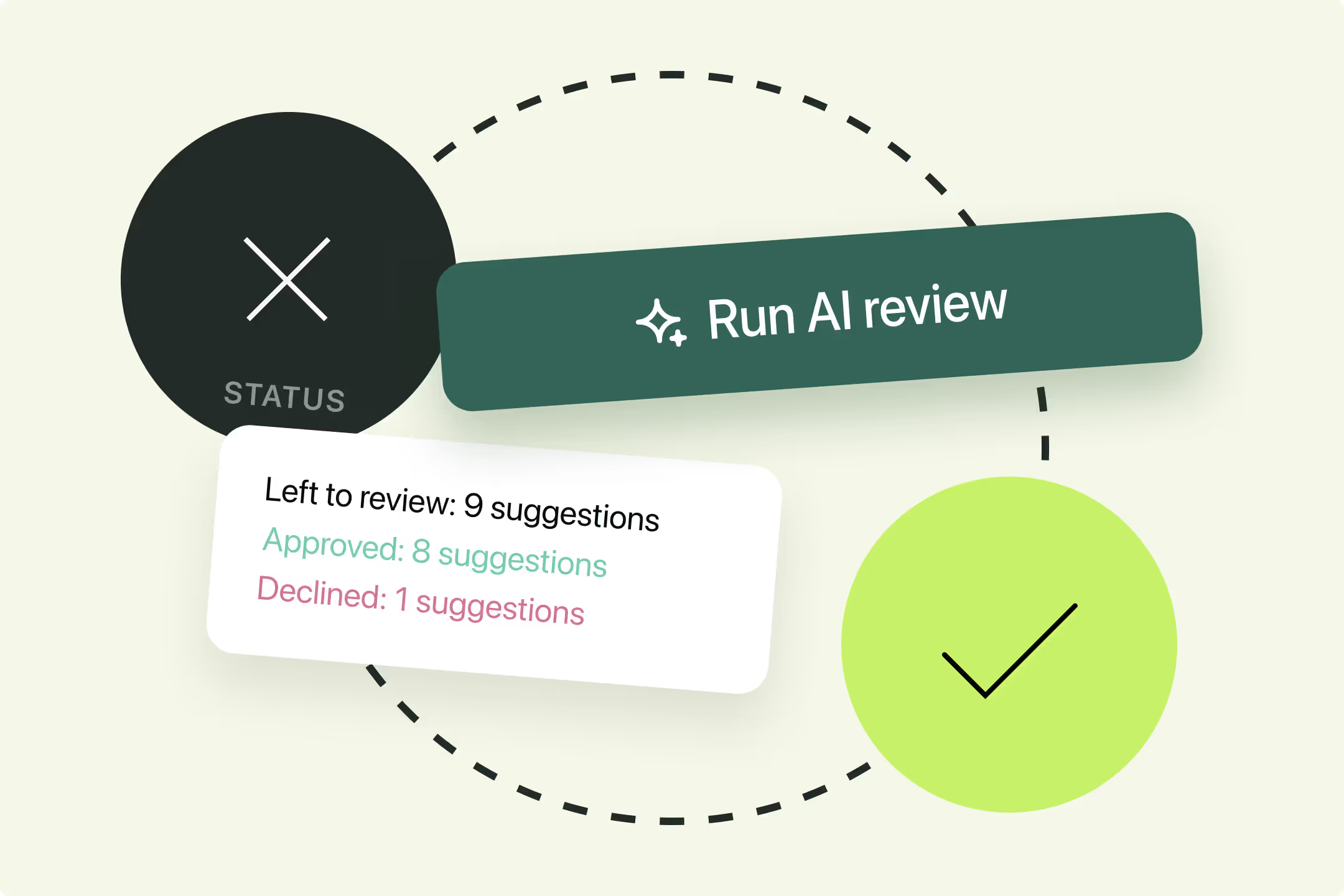
This frees up time for higher-value work, and the potential is only set to grow as AI agents develop and make their way into the tech stack.
The sooner you consider what you can automate safely, the sooner you can reclaim your time for the strategic work that needs your expertise the most. Contract review is a great place to start.
To find out how Juro can enable your business to automate repetitive contract admin and put your legal front door in good stead, hit the button below to speak to our team.

If there are no defined response times or prioritization guidelines, business teams won’t know what to expect, and legal will struggle to manage workloads effectively - even with a legal front door in place.
There are lots of ways you can track these service levels, but a contract management software will make this tracking effortless.
For example, Juro's analytics functionality allows you to track the efficiency of your contract lifecycle end to end, measuring everything from average time between contract creation and signing to the volume of contracts agreed in the last 30 days.
This makes it easier than ever to monitor performance against legal KPIs and identfy bottlenecks before they stunt commercial growth.
{{quote3}}
Implementing a legal front door isn’t just about reducing inbox clutter—it has a tangible impact on business operations. Companies that introduce structured legal intake see:
Efficiency is everything for businesses in 2026. A legal front door helps legal teams work smarter, not harder—empowering them to support growth without becoming a roadblock.
That's why Juro embeds AI contract automation in the tools business teams already use, so they can agree and manage contracts end-to-end - while legal stays in control.
If you're using Slack day-to-day already, you're in luck. Juro integrates seamlessly with Slack, enabling businesses to make the popular communications platform their new legal front door.
Users can track the progress of their contracts in Slack with real-time notifications for redlines, signatures, and more, meaning increased visibility and no more chasing legal.
This means that non-legal teams no longer need to jump between several different tools or log into the CLM platform to work on contracts. They can self-serve quickly and easily without ever leaving Slack. Plus, less low-value contract work lands on legal's desk. It's a win-win.
To find out whether Juro's intelligent contract solution would be a good fit for your business, fill in the form below.
Lorem ipsum dolor sit amet, consectetur adipiscing elit. Suspendisse varius enim in eros elementum tristique. Duis cursus, mi quis viverra ornare, eros dolor interdum nulla, ut commodo diam libero vitae erat. Aenean faucibus nibh et justo cursus id rutrum lorem imperdiet. Nunc ut sem vitae risus tristique posuere.


Hello. We are Juro Online Limited (known by humans as Juro). Here's a summary of how we protect your data and respect your privacy.





Stephanie Ng-Fragner, General Counsel at Oper Credits
Stephanie Ng-Fragner, General Counsel at Oper Credits
.avif)
Okechukwu Eke, General Counsel at Moniepoint