


🇺🇸 22 Boston Wharf Rd, Boston, MA 02210
🇬🇧 2 Pear Tree Court, London EC1R 0DS
© 2026, Juro. All rights reserved.


🇺🇸 22 Boston Wharf Rd, Boston, MA 02210
🇬🇧 2 Pear Tree Court, London EC1R 0DS
© 2026, Juro. All rights reserved.

Use this security guard contract template to set out the services and liability terms between a business and its security provider.



"It takes the sales team four clicks to generate and approve a contract in Juro. We're saving 25 minutes per contract."
Read Paddle's customer story >

Chris McFalls,
Rev Ops
"With Juro, approvals take less than two hours, and most contracts are fully signed within a day of being sent"
Read Goldin’s customer story >

Kyle Piper,
Contracts Manager
"Everyone works out of Juro - it's the key tool we use to do our job"
Read ANC’s customer story >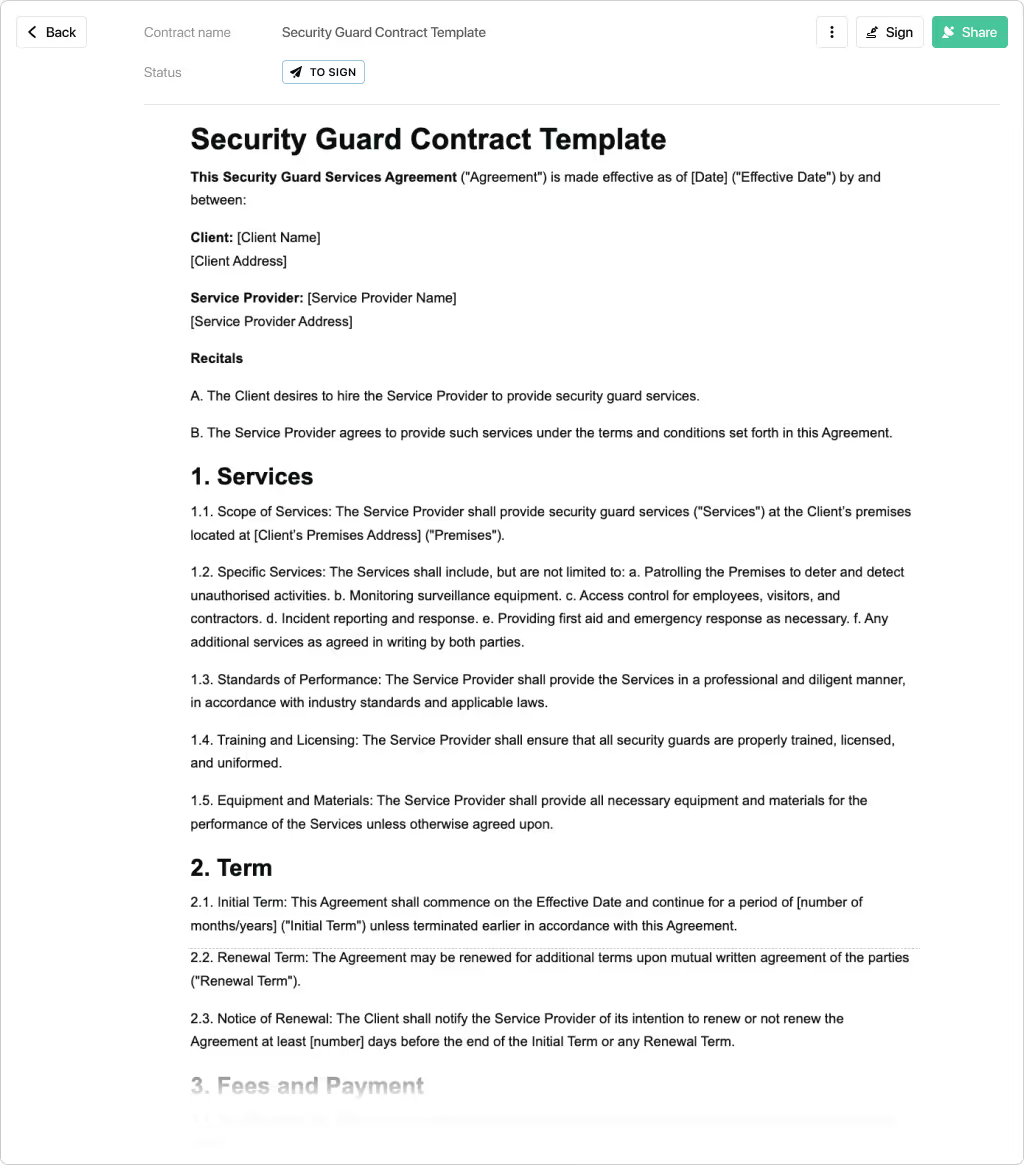


This article explores what security guard contracts are, their purpose, management, and how to streamline the end-to-end process with Juro.
A security guard contract is a legally binding agreement between a business (the client) and a security service provider (the contractor). This document outlines the terms and conditions under which the security services will be provided, including the scope of work, payment terms, responsibilities and liabilities of both parties day-to-day.
The primary purpose of a security guard contract is to establish clear expectations and responsibilities for both the client and the security service provider. By doing so, it helps prevent misunderstandings and disputes. Key objectives of a security guard contract include:
Several key roles within an organization typically manage security guard contracts:

Security guard contracts are essential in various scenarios to ensure safety, prevent theft and manage access control. Here are some common situations where these contracts are used:
Security guard contracts help ensure the safety and security of employees, visitors and company assets. They cover services like patrolling the premises, monitoring entry and exit points, responding to emergencies, and managing security systems. Contracts also specify the security protocols to handle incidents like unauthorized access, workplace violence or fire emergencies.
Retail stores use security guard contracts to prevent theft, manage crowd control and ensure the safety of customers and staff. Guards are tasked with monitoring surveillance cameras, conducting regular patrols and handling shoplifting incidents. The contracts outline the guards' responsibilities, including procedures for detaining suspects and collaborating with law enforcement.
Events such as concerts, conferences and large gatherings require detailed security planning. Security guard contracts for these scenarios include services like crowd management, access control, emergency response and VIP protection. They specify the deployment of guards at strategic locations, protocols for handling disturbances and coordination with event organizers to ensure smooth operations.
Residential complexes rely on security guard contracts to maintain a safe living environment for residents. These contracts cover services such as 24/7 patrolling, monitoring security systems, managing visitor access and responding to emergencies. The contract details the guards' duties – which may include enforcing community rules, assisting residents in distress and coordinating with local law enforcement when necessary.
Construction sites are vulnerable to theft and vandalism, making security guard contracts crucial for protecting valuable equipment and materials. These contracts include services like patrolling the site, monitoring entry and exit points, and responding to security breaches. They outline the procedures for guards to follow, such as inspecting deliveries, checking workers' credentials and reporting incidents to site management.
A comprehensive security guard contract template should include the following elements:
Parties involved. Names and addresses of the client and the security service provider.
Scope of services. Detailed description of the security services to be provided.
Duration of the contract. Start and end dates, including provisions for renewal.
Payment terms. Fees, invoicing schedule, and payment terms and due dates.
Responsibilities. Duties of the security personnel and the client’s obligations.
Liability and insurance. Allocation of liability and required insurance coverage.
Termination clause. Conditions under which the contract can be terminated by either party.
Confidentiality. Protection of sensitive information.
Dispute resolution. Methods for resolving any disputes that may arise.
Compliance. Adherence to relevant laws and regulations.
Managing security guard contract templates involves various methods and tools, each with its own set of challenges and efficiencies. Here’s a detailed look at how these contracts are typically managed:
Traditionally, security guard contracts are drafted and edited manually using word processors. Legal and HR teams often create these documents from scratch or modify existing templates to suit specific needs. This process involves:
While this method allows for customization, it can be time-consuming and increases the risk of errors due to manual input.
Email is commonly used to share contract drafts and revisions among stakeholders. The process typically includes:
This method can lead to confusion and errors due to the challenges of managing multiple email threads and document versions.

Once contracts are finalized and signed, they are often stored physically in filing cabinets or other storage systems. This involves:
Physical storage poses risks such as document loss, damage, and limited accessibility, especially in urgent situations.
Digital storage solutions, such as cloud storage, are increasingly used to manage security guard contracts. This method includes:
While digital storage improves accessibility and reduces the risk of physical damage, it still relies on manual processes for document management and retrieval.
Managing security guard contract templates can present several challenges:
Juro offers an AI-native contract automation platform designed to streamline the creation, execution, and management of security guard contracts. Here’s how Juro can help:

By using Juro, HR and legal teams can overcome the common challenges associated with managing security guard contracts, ensuring a more efficient and compliant contracting process.
Juro's AI-native contract automation platform empowers all teams to create, agree, execute and manage contracts up to 10x faster than traditional tools. To find out more, hit the button below to book your personalized demo.
A security guard contract template is a ready-made agreement that a business can adapt each time it hires a security company to protect its premises or an event. It describes the services the guards will provide, such as patrols and access control. It also records who carries the risk if a guard is hurt or property goes missing.
Usually, yes. A single night of crowd control can still lead to an injured guest or a damage claim, and without a contract it’s unclear whether the security company’s insurance covers it. A short agreement that confirms staffing levels and the insurance in place takes little time to complete.
A service agreement is a general template for any business that provides services to a client. A security guard contract adds the terms that matter when people are protecting property and dealing with the public, such as incident reporting and what guards may do if they catch someone stealing.
Ask the security company to carry general liability insurance and, where possible, to name your business as an additional insured, then check the certificate before the first shift. Liability causes the most disputes, because incidents involving guards can lead to claims for injury or wrongful detention. Make sure the contract says who pays in each case, and that any cap on the provider’s liability isn’t lower than the insurance it holds.
Yes. The contract should say whether guards can detain suspected shoplifters or use physical force, and how they hand incidents over to the police. What security staff are allowed to do varies by state and country, so the rules in the contract should match local law and the guards’ licenses.
It’s a sound starting point, but it works best when you tailor the scope of services and the insurance terms to each site and remove anything that doesn’t apply. An event and a long-term contract for an office building usually need different staffing and termination terms. For specific legal advice on your contract templates, consult an attorney.
Build the template in Juro once and let procurement or facilities generate each security guard contract from it, filling in the site and the services needed. When your standard position changes, for example on insurance limits, you update that one template and every new contract uses it. Signed contracts live in one place, so you can search them for renewal dates and insurance requirements before a contract rolls over.
Yes. Juro’s Operator drafts new templates from the contracts you already have, learning your drafting style and the positions you usually take on terms like liability caps and insurance. Your legal team approves the first draft before anyone uses it, so the template reflects your risk appetite from day one.
Answer
Juro is the #1-rated contract platform for speed of implementation — connect your CRM, automate templates, and close deals without the paperwork.
Book a personalised demo

Hello. We are Juro Online Limited (known by humans as Juro). Here's a summary of how we protect your data and respect your privacy.