

.svg)


.svg)


🇺🇸 22 Boston Wharf Rd, Boston, MA 02210
🇬🇧 2 Pear Tree Court, London EC1R 0DS
© 2025, Juro. All rights reserved.

🇺🇸 22 Boston Wharf Rd, Boston, MA 02210
🇬🇧 2 Pear Tree Court, London EC1R 0DS
© 2025, Juro. All rights reserved.


Contracts are the connective tissue of every business — they define how revenue is captured, how suppliers are managed, and how teams stay compliant. But in too many organisations, contracting remains fragmented: Word files live in email threads, signatures sit in a separate app, and no one can say for sure which version is final.
That’s why contract lifecycle management (CLM) software has moved from niche legal tech to a strategic priority for every growing company. In 2026, the best CLM platforms don’t just store contracts — they run the contracting process from end to end, combining automation, data, and collaboration in a single system.
Contract lifecycle management software is a tool that enables legal and commercial teams to streamline, automate, and speed up the management of contracts throughout their lifecycle.
CLM systems deliver value at every stage of the contract lifecycle, covering contract creation, review, negotiation, approvals, signing, storing, tracking and renewals.
This distinguishes it from point solutions like contract negotiation software or contract reminder software that focus on one particular phase of the contract lifecycle.

For legal teams, CLM is about control. For everyone else, it’s about speed. And in 2026, both matter more than ever.
Sales teams can’t afford delays waiting for legal to draft a contract. Talent teams need to issue offer letters in hours, not days. Finance needs visibility into obligations and renewals without chasing spreadsheets.
A modern CLM platform addresses all three problems at once — and that’s why adoption is accelerating.
To understand what CLM actually does, it helps to walk through a typical contract journey.
At each stage, CLM software removes manual effort and human error, while keeping legal in control of the playbook.
If this sounds like something that would benefit your business, hit the button below to find out more. To compare contract lifecycle management software vendors and use cases, read on.
Juro embeds contracting in the tools business teams use every day, so they can agree and manage contracts end-to-end - while legal stays in control.

For many businesses, the contract lifecycle is a fragmented, slow, and inefficient process.
Contracts are drafted in Microsoft Word, shared via email, signed in eSignature tools, stored in shared drives, and eventually tracked in Excel spreadsheets.
This means that companies rely on up to six different tools to manage their contracts, and moving back and forth between these different platforms results in friction and data loss.
A CLM solution like Juro transforms this process, enabling your team to trade a chaotic contracting tech stack for a single, unified workspace where contracts are managed end-to-end.

For Tibber, this transition didn’t just welcome a more frictionless process. It also saved the business money in the long-run by reducing unnecessary tooling:
“We saved $8000 a year having cancelled our subscription to the eSigning platform - Juro has a native eSignature, and covers the pre- and post- signature stages. That’s the biggest return on investment” - Ulrika Leikvang, Head of Legal, Tibber
Another benefit of CLM software is that it captures key data from contracts throughout their lifecycle. You can monitor everything from your contract values to risk exposure, upcoming contract milestones, and compliance.

This makes it easier than ever to record, track, report on, and analyze these metrics for internal and external purposes, like fundraises, for example:
“In a few clicks, the contracts are saved in one place, and we derisk in terms of data management and keeping track of our legal documents. When you’re pulling together a data room for a fundraise, this is invaluable” - Clio Anderson Garwood, Senior Legal Counsel, Paddle
While exciting, these big events can already put legal teams under pressure, with plenty of strategic and compliance work to pick up.
Having to find, aggregate, and manually extract data from all of your contracts in the process can be avoided easily by adopting a contract lifecycle management tool like Juro:
“When contracts were spread across up to six different tools, there was no way to measure the time spent at different stages. With Juro, we’ve consolidated the process and now have structured data to give us these insights” - Davis Troutman, Product Manager, Placemakr
Contract collaboration is often painful when it happens in several different places simultaneously.
Redlines fall through the cracks of email inboxes, tracked changes are lost when new versions are created, commercial teams drop time-sensitive requests on legal teams via Slack or Teams.
Contract lifecycle management software facilitates conversations and negotiations by providing a single workspace for comments, approvals and redlines. Juro users can even automate workflows so that only high-value contracts, or those that meet certain criteria require intervention from senior management.

With a CLM system in place, you can track the progress of a contract in real time, with a detailed audit trail of the actions that have taken place - and those blocking the agreement from getting over the line.
In fact, our State of In-house Report 2024 found that lawyers are 1.5x more likely to feel friction with sales team when they don't have a CLM solution in place. Juro solves for this:
“Juro is great for collaboration and transparency into the contract lifecycle because everything lives in one space” - Maryke Richards, Snr Legal Counsel, Takealot
CLM software is typically used by legal and commercial teams in businesses that process a high volume of routine contracts and can benefit from legal automation.
In particular, legal teams use CLM software to streamline day-to-day contracting and enable other business teams to automate routine contracts in a safe and controlled way. This, in turn, frees up legal's time, enabling them to work on higher-value projects and upskill in new areas.
But it isn't just legal teams that can benefit from CLM tools like Juro. A solution like Juro can also be used to enable and improve processes for other teams in the business.

The contract lifecycle management features you need typically depend on the work you're doing, and which areas you can optimize your current process to increase efficiency. However, most businesses will benefit from the following CLM features:

As we mentioned, every business will have different CLM requirements, so you should scope out exactly what you need from a platform and evaluate them accordingly.
There are plenty of contract lifecycle management solutions on the market, each with a different set of features, benefits and limitations. To make your vendor research that bit easier, we've compiled a list of the best contract lifecycle management software in 2025, with a list of benefits and limitations of each shared by real, verified users.
Also known as intelligent contract automation, Juro is an evolution of contract lifecycle management software. It empowers scaling businesses to create, agree, execute and manage contracts up to 10x faster than traditional tools.
Juro is the only platform specifically designed to work for both legal and commercial teams, resulting in faster contracting cycles, lower costs and reduced risk across the business. Juro is also highly flexible, meaning it is fast to implement and easy to maintain.
.avif)
Juro is the best contract lifecycle management software for legal and commercial teams in scaling businesses with large contract volumes. Unlike most contract lifecycle management solutions, Juro was designed for both legal and business teams, enabling them to:
Juro powers millions of contracts for the world's fastest growing businesses, including companies like Remote, Deliveroo, Trustpilot, The RealReal, AngelList and QuantumScape. To find out more about how Juro could work for your business, book a demo today.
Contractbook is a popular contract management solution that works well for small sales and operations teams processing some standard contracts, and storing signed PDFs.
The main value area for users is the post-signature contract management functionality. It offers the features you need to filter, search, sort, and organize contracts. It also embeds AI in these workflows - like Juro.
Contractbook does also offer some limited pre-signature contract management features, and a native electronic signature solution.
However, these aren’t as comprehensive as those offered by Juro, and these limitations mean that Contractbook might lack the more nuanced functionality that legal teams need to set conditions and retain control of contracts across the business.
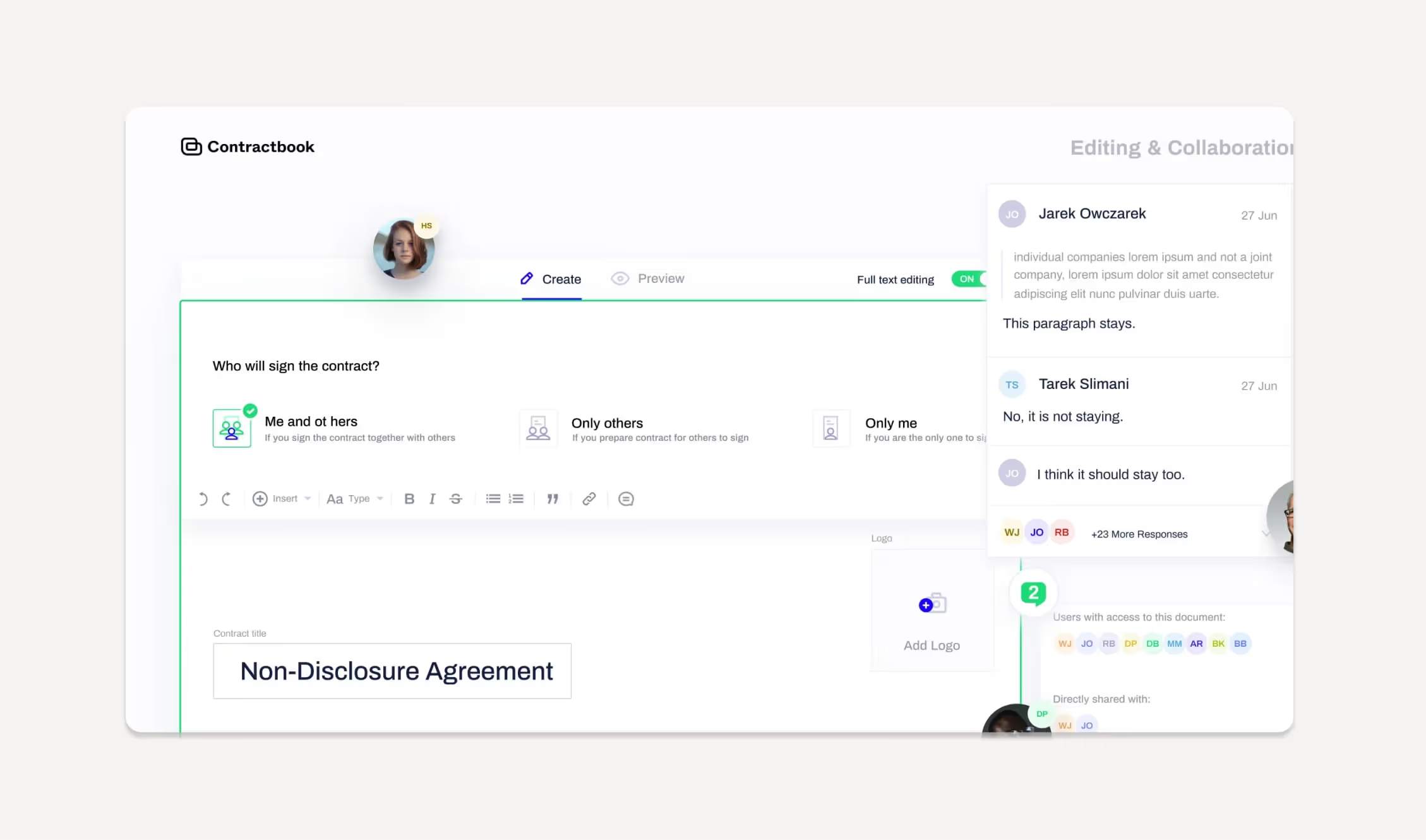
This CLM solution is best-suited to small sales and revenue operations teams that want to store and monitor commercial agreements at scale.
It’s particularly useful for those that want to integrate contracts with their CRMs to streamline processes, but it’s less useful for complex legal documents that require more back-and-forth between parties.
SAP Ariba Contracts is a CLM solution that enables procurement and sales teams to create and agree contracts in a more consistent way. This contract lifecycle management software specializes in post-signature contract workflows, with powerful reporting functionality and the ability to monitor spend history and compliance in real time.
Since SAP Ariba also offers sourcing, invoicing, and payment processing functionality, this contract lifecycle management software is a good fit for enterprise businesses that have complex procurement requirements.

SAP Ariba’s contract lifecycle management solution is best suited to large businesses that are willing to compromise ease for functionality. It works for procurement teams in large corporate environments as it can support other tasks, like sourcing and invoicing. However, it is less suitable for legal and commercial teams in scaling businesses that want a tool that's flexible and easy to use.
Icertis is another CLM platform that focuses on post-signature contract management and integrates seamlessly with ERP and spend management systems.
Icertis’ strongest functionality is its contract repository and reporting capabilities, with many users recognizing the CLM tool as a contract intelligence platform. This is what makes it a popular choice for businesses that need a firm grasp on governance and compliance.

Given the CLM platform’s emphasis on governance and compliance, Icertis is most suitable for enterprise companies with strict regulatory requirements. It’s also a good option for businesses with more complex contract processes and requirements because it is highly customizable. However, due to its complexity, this CLM software is less suitable for businesses that want to automate routine contracts and want to get to value quickly.
Agiloft is one of the oldest contract lifecycle management tools on the market, renowned for its enterprise-grade features and security. Like most legacy CLM systems, Agiloft is highly customizable, with plenty of features for users to take advantage of. Agiloft’s customers include Moderna, Chevron and Taylormade to name a few.
.avif)
Agiloft is most suitable for businesses that require a high level of configurability, with the platform offering an extensive set of features. However, independent reviews suggest that this level of configuration requires a lot of technical expertise and time to use and implement. This makes it a weaker solution for businesses without these resources in place.
When it comes to choosing the right CLM software for your business, there are a few things you need to consider:

Juro helps teams agree and manage contracts up to 10x faster by bringing legal and business users together in one collaborative workspace.
It’s trusted by thousands of companies — from Deliveroo to Remote — and powers millions of contracts globally.
Teams choose Juro because it’s:
Juro is very easy to use amongst lawyers and non-lawyers! Many different teams within our business benefit from Juro - Verified Juro user, G2 review
Juro is the first CLM I've encountered that has truly been adopted (and enjoyed) by various company departments/stakeholders - Verified Juro user, G2 review
Juro is trusted by 6000+ of the world's leading companies and is one of the top-rated contract lifecycle management platforms according to G2. Book a personalised demo to see how Juro can transform the way your teams agree, execute and manage contracts.

Sofia Tyson is the Senior Content Manager at Juro, where she has spent years as a legal content strategist and writer, specializing in legal tech and contract management.
Sofia has a Bachelor of Laws (LLB) from the University of Leeds School of Law where she studied the intersection of law and technology in detail and received the Hughes Discretionary Award for outstanding performance. Following her degree, Sofia's legal research on GDPR consent requirements was published in established law journals and hosted on HeinOnline, and she has spent the last five years researching and writing about contract processes and technology.
Before joining Juro, Sofia gained hands-on experience through short work placements at leading international law firms, including Allen & Overy. She also completed the Sutton Trust’s Pathways to Law and Pathways to Law Plus programs over the course of five years, building a deep understanding of the legal landscape and completing pro-bono legal volunteering.
Sofia is passionate about making the legal profession more accessible, and she has appeared in several publications discussing alternative legal careers.


Hello. We are Juro Online Limited (known by humans as Juro). Here's a summary of how we protect your data and respect your privacy.


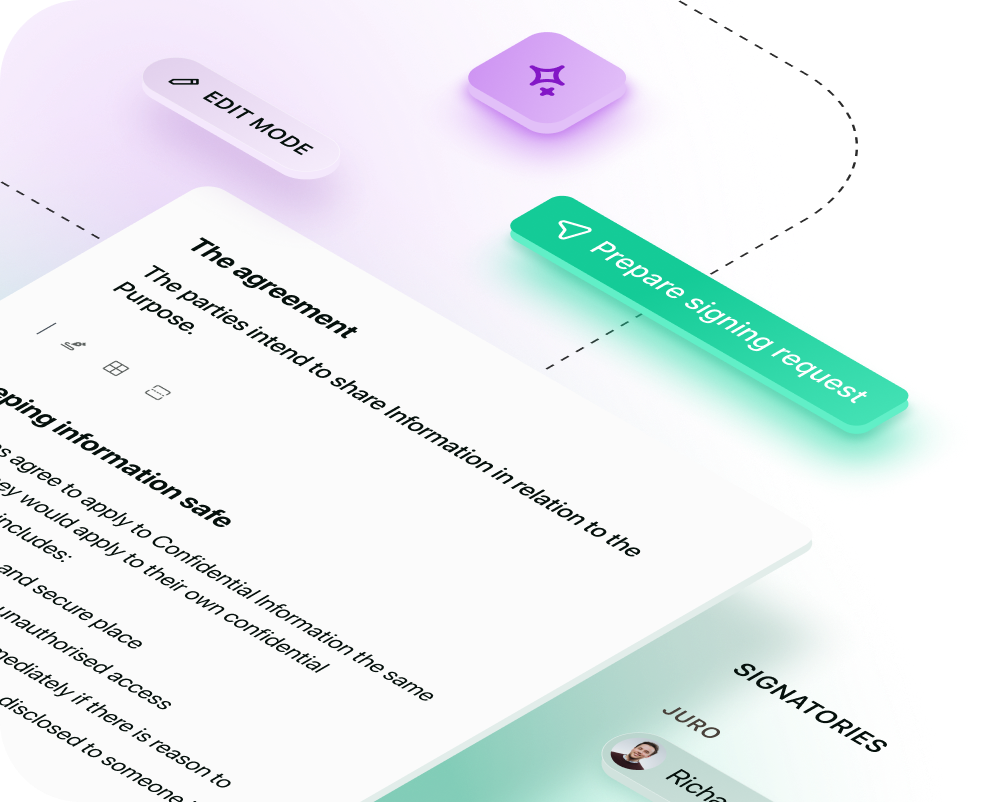
Juro embeds contracting in the tools business teams use every day, so they can agree and manage contracts end-to-end - while legal stays in control.
Book your demo

