


.svg)

.svg)
.svg)

🇺🇸 22 Boston Wharf Rd, Boston, MA 02210
🇬🇧 2 Pear Tree Court, London EC1R 0DS
© 2026, Juro. All rights reserved.


🇺🇸 22 Boston Wharf Rd, Boston, MA 02210
🇬🇧 2 Pear Tree Court, London EC1R 0DS
© 2026, Juro. All rights reserved.

When finance teams track contracts in spreadsheets, it's rarely because nobody thought to do it differently.
It's a reasonable decision. A spreadsheet is free, familiar and fast to set up. For a business with a handful of vendor contracts and a renewals calendar that fits on one screen, it works.
The problem isn't the spreadsheet. It's that businesses don't stay that size, and they quickly outgrow the manual approach to contract tracking that lives in Excel spreadsheets.
The problem surfaces gradually. A new SaaS tool here, an amended MSA there, a contract signed by a team lead that never made it into the master sheet.
By the time a spreadsheet-based contract tracking system starts to fail, it's usually been failing quietly for months: missed renewal windows, incorrect committed spend figures, reports assembled under pressure that nobody fully trusts.
And it's not uncommon:
This is the real cost of spreadsheet-based contract tracking. Not the tool itself, but what it hides.
Most commentary on this topic focuses on legal teams. But the consequences often land hardest in finance.
Legal teams deal with spreadsheet limitations through effort - chasing contracts, manually reviewing documents before renewals, building workarounds. Finance teams deal with them through uncertainty.
When the data underpinning a budget forecast or a committed spend report comes from a spreadsheet that may be incomplete, finance is making decisions on numbers it can't fully stand behind.
That uncertainty has three specific sources.
A contract spreadsheet is a derivative document. Someone reads a contract, extracts what they think is the relevant information and enters it into a cell.
Every step in that process is an opportunity for error: wrong date, wrong value, old version of the contract, a field interpreted differently by different people.
Unlike a system that reads directly from the signed document, a spreadsheet introduces a layer of human interpretation between the contract and the data.
Contracts get amended. Notice periods change. Payment schedules are renegotiated. A spreadsheet reflects the contract as it was when someone last updated it - which may not be how it reads today.
For finance teams using contract data to forecast or report, a spreadsheet that's two months out of date is as dangerous as no spreadsheet at all.
The contracts that end up in a spreadsheet are the ones someone knew to put there.
Shadow IT purchases, contracts signed at team level without central procurement, legacy agreements inherited through an acquisition - these often don't make it in. But their financial obligations exist regardless, and they will come back to bite you if neglected.

The cost of spreadsheet-based contract tracking isn't just staff time, though that's real too.
The most common is a renewal nobody caught. An auto-renewal clause kicks in, the contract rolls over, and the invoice arrives outside the budget. For a business with 80 vendor contracts, missing just a handful a year adds up fast - and each one is a conversation finance didn't want to have.
Spend reporting suffers too. If the data behind your committed spend figures is out of date, every report built on it is wrong.
Then there's due diligence. When a funding round triggers a contract audit, investors want a complete picture of every commitment the business has made. A spreadsheet with gaps and no contract audit trail is a hard thing to hand over.
The case for CLM software is sometimes framed as a technology investment decision: what does a CLM cost vs what does the spreadsheet cost? But that framing understates the real cost of manual contract tracking.
At face value, spreadsheet tracking is free with any Google (Google Sheets) or Microsoft (MS Excel) business suite package. But in reality, the true cost of spreadsheet-based contract tracking is far greater:
Let's imagine a scenario that illustrates the value and risk involved in both approaches.
A scaling business - around 120 employees, 90 active vendor contracts, a two-person finance team - is managing contracts in a shared spreadsheet that's been maintained by whoever had time.
The spreadsheet has renewal dates, but not notice periods. It has contract values, but not payment schedules. Around 15 contracts added in the past 18 months aren't captured in the spreadsheet at all. Nobody knows exactly which ones.
In one quarter, three contracts renew automatically. Two of them the business would have canceled. Combined value: $41,000. The finance manager discovers this when the invoices arrive. The contracts are locked in for another year, and the spend is already committed.
Six months later, the business raises a Series A. The due diligence process requires a full schedule of contractual commitments. It takes the finance and legal teams weeks to assemble it, working from a combination of the spreadsheet, email inboxes and a shared drive that hasn't been organized in two years. Several contracts are missing from the first draft. The investor notices, and tricky questions arise.

Now run the same scenario with a robust contract management solution in place from the start.
All vendor contracts sit in Juro's intelligent repository. Payment terms, renewal dates and notice periods were extracted automatically when contracts were uploaded due to them being pre-defined smartfields in automated contract templates.
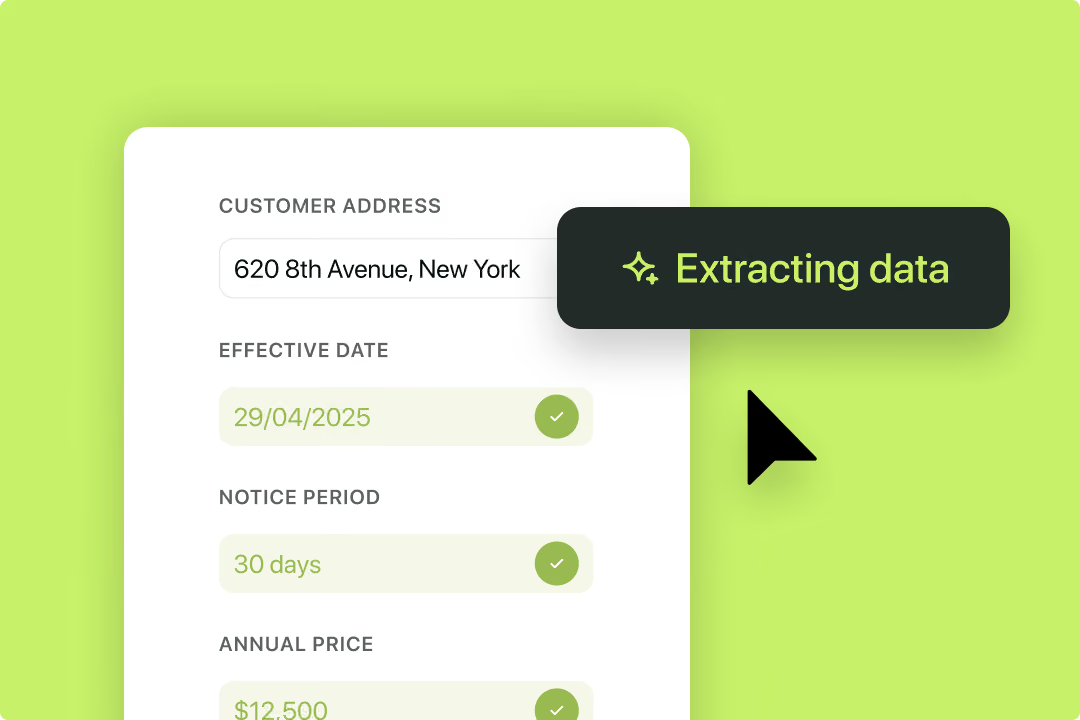
Contract reminders fire 90 days before each anniversary. The finance manager reviews upcoming renewals monthly and cancels the two contracts that aren't delivering value. When due diligence comes, the committed spend schedule takes 20 minutes to generate.
The difference isn't just the technology in place, it's the quality of information available at every decision point.
The most common objection to CLM adoption in finance teams isn't cost. It's the effort of transitioning between the two.
There's an assumption that migrating from a spreadsheet to a new system requires a data cleansing project, a change management program and months of implementation before anything works.
That assumption is usually wrong, for a few reasons.
First, a modern CLM built for lean teams doesn't ask you to start with clean data.
Juro's AI extraction capability reads contracts directly - PDFs, Word documents, third-party paper - and pulls out the key fields automatically. You don't need a perfect spreadsheet to migrate. You need the contracts themselves, which you already have.
Second, the transition argument gets the direction of causality backwards.
Finance teams often feel they need to get the spreadsheet right before moving to a new system. In practice, the CLM is precisely what makes the data reliable. The spreadsheet can never fix itself. That's the point.
CLM adoption tends to be driven by legal teams who are already feeling the strain of manual contract management processes.
Finance and legal are typically solving versions of the same problem. A platform like Juro that's designed and proven to suit both legal and finance teams removes the internal politics from the conversation and improves cross-functional collaboration.
Juro is an AI-native contracting system built for lean legal and finance teams who need to move fast without sacrificing visibility or control.
It embeds in the tools your team already uses, with no lengthy implementation, and no dedicated legal ops function required to get value from it.
Juro replaces spreadsheet-based contract tracking with a searchable, structured repository that works for your whole business - not just legal. The features that matter most to finance are:
If your contract tracking still lives in a spreadsheet, the problem isn't the spreadsheet. It's everything the spreadsheet can't tell you.
Book a demo with Juro to see how teams like yours have made the switch.

Lorem ipsum dolor sit amet, consectetur adipiscing elit. Suspendisse varius enim in eros elementum tristique. Duis cursus, mi quis viverra ornare, eros dolor interdum nulla, ut commodo diam libero vitae erat. Aenean faucibus nibh et justo cursus id rutrum lorem imperdiet. Nunc ut sem vitae risus tristique posuere.


Hello. We are Juro Online Limited (known by humans as Juro). Here's a summary of how we protect your data and respect your privacy.