


.svg)

.svg)
.svg)

🇺🇸 22 Boston Wharf Rd, Boston, MA 02210
🇬🇧 2 Pear Tree Court, London EC1R 0DS
© 2026, Juro. All rights reserved.


🇺🇸 22 Boston Wharf Rd, Boston, MA 02210
🇬🇧 2 Pear Tree Court, London EC1R 0DS
© 2026, Juro. All rights reserved.

Net payment terms define when a buyer must pay an invoice, and that single variable shapes cash flow, working capital, and financial risk across every business relationship a company has.
But for finance teams managing dozens or hundreds of supplier and customer contracts, payment terms are anything but simple.
They shape cash flow, affect borrowing costs, determine when revenue can be recognized, and, when they're inconsistent across a portfolio, create real financial risk.
With that in mind, this guide covers what net payment terms are, how they work in practice, and how finance teams can get better control over them at scale.
Net payment terms define the period a buyer has to pay an invoice in full after it has been issued. The word "net" refers to the total amount due, not a discounted figure.
For example, net 30 payment terms mean the full invoice value must be paid within 30 days of the triggering event, usually the invoice date.
Net payment terms are standard in B2B commercial contracts across industries. The specific terms used in any given relationship are typically a function of negotiating leverage, industry convention, the buyer's credit profile, and the supplier's liquidity needs.
The most common variants are net 15 payment terms, net 30, net 60, and net 90.
Some financial contracts use "due on receipt" or "payable immediately," which means the invoice is due when it's delivered rather than after a set period.
The specific term a business uses in its contracts has a direct impact on working capital. A company offering net 60 to all its customers, while paying its own suppliers on net 30, is effectively financing a cash gap from its own balance sheet.
Net payment terms are typically defined in the body of a commercial contract, often in a contract's payment obligations section, or embedded in a purchase order or master services agreement. Standard language looks like:
"Invoices are payable within 30 days of the invoice date."
More detailed versions specify conditions:
"Payment terms are net 60 days from the date of receipt of a valid invoice, provided such invoice meets the requirements set out in Schedule 2."
That conditionality matters. Contracts frequently tie the start of the payment clock to specific requirements: the invoice must reference a purchase order number, confirm delivery, or be sent to a specific address. If the invoice doesn't meet those conditions, the payment window may not start until it's corrected. For instance, a net 30 contract can effectively become net 45 if invoice validation is slow.
That's why precision in drafting is so important. Language like "payment will be made promptly" or "invoices are due on a timely basis" creates disputes. Well-drafted payment terms specify the triggering event (invoice date, receipt date, acceptance date), the period, the payment method, and any conditions for a valid invoice.
More on that in our guide to avoiding contract ambiguity.
Beyond standard discount notations like 2/10 net 30, some businesses use dynamic discounting platforms that offer sliding-scale early payment across the supplier base.
The earlier the payment, the larger the discount, giving buyers flexibility to deploy excess cash productively and giving suppliers access to liquidity without taking on debt.
Whether a dynamic discounting program makes sense depends on the business's cash position, transaction volume, and operational bandwidth. Finance teams should weigh the cost of capital against the overhead of running the program before committing.
Contract payment terms are often negotiated based on leverage, and the interests of buyers and suppliers pull in opposite directions:
1. Suppliers want shorter payment terms because cash received sooner means less reliance on credit lines, lower financing costs, and more predictability in cash flow. A small supplier offering net 30 to a large buyer may be absorbing significant working capital strain while waiting to be paid.
2. Buyers prefer longer payment terms because they can hold cash for longer, reduce short-term borrowing needs, and maintain flexibility. Large enterprises with strong balance sheets regularly push for net 60 or net 90 as a matter of course.
For a finance team managing both payables and receivables, the interplay between the two creates a working capital position that determines how much cash the business needs to operate day-to-day.
A company with net 30 payables and net 60 receivables is perpetually in a cash gap: it pays suppliers before it collects from customers.
Understanding this dynamic helps explain why payment terms are genuinely strategic, not just administrative boilerplate.
For most businesses, the real problem with net payment terms isn't any single agreement. It's the lack of consistency across the portfolio as a whole.
Without robust and systematic oversight, terms accumulate organically. Sales teams agree to whatever customers ask for. Procurement accepts whatever suppliers propose. Renewal contracts get updated while originals remain on file.
Over time, a business can have customers on net 15, net 30, net 45, and net 60, all in different formats, in different systems, with no single view of the commitments made.
The consequences are significant.
The first step toward better control is visibility: knowing what net payment terms actually exist across the portfolio.
For many finance teams, that means extracting payment term data from signed contracts. A contract might define terms in the body, in a schedule, in a purchase order incorporated by reference, or in an amendment. Done manually, it's slow and error-prone.
Once the data exists, the next step is analysis: the distribution of terms across the portfolio, outliers, and contracts where terms are ambiguous or absent. Then standardization:
Done manually, this is a one-time exercise. With the right tools, it becomes an ongoing capability.
The core challenge finance teams face with net payment terms isn't understanding what they mean in the abstract. It's getting visibility into them across a live portfolio of signed contracts.
Juro's intelligent contract repository addresses this directly. The functionality brings all contracts into one place, and AI Extract pulls payment term data from signed agreements automatically, including the triggering event, the period, any conditions, and early payment provisions. That data becomes instantly reportable, without anyone manually reading through contracts to find it.
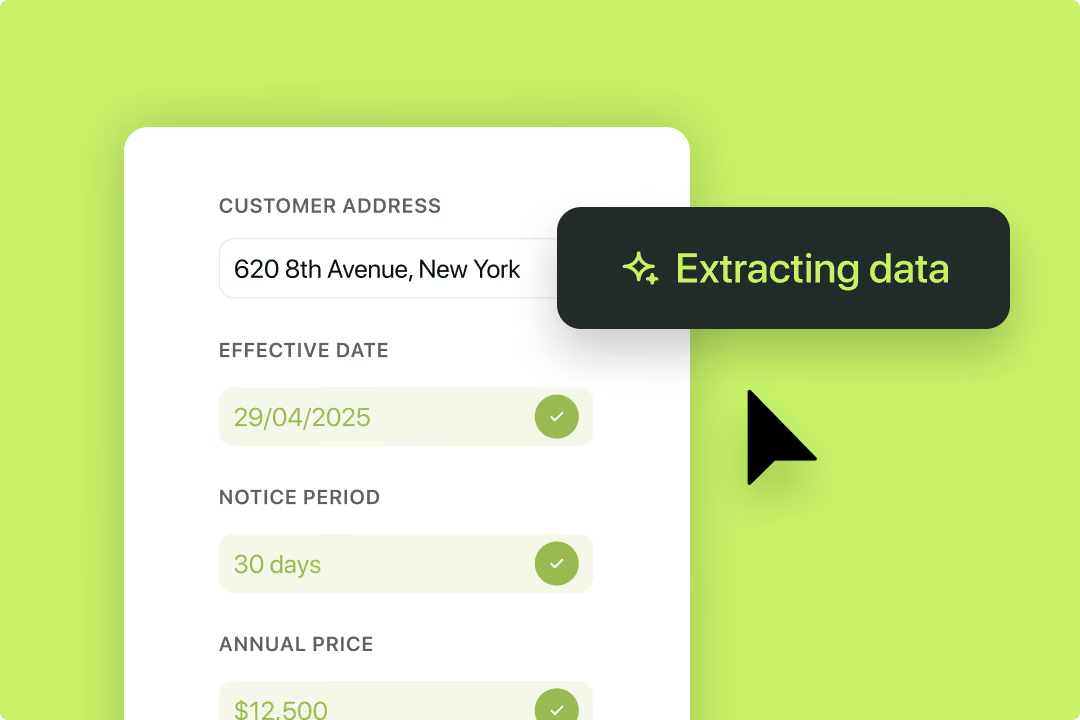
Juro's Operator allows finance teams to query that data even further: which contracts are on non-standard terms, which renewals are approaching where renegotiation makes sense, which supplier agreements include late payment clauses. What would otherwise require hours of manual review becomes a question answered in minutes.
When it comes to preventing the chaos of misaligned contract terms, Juro's automated contract templates ensure new contracts are created on approved language by default, so non-standard net payment terms don't accumulate in the first place.
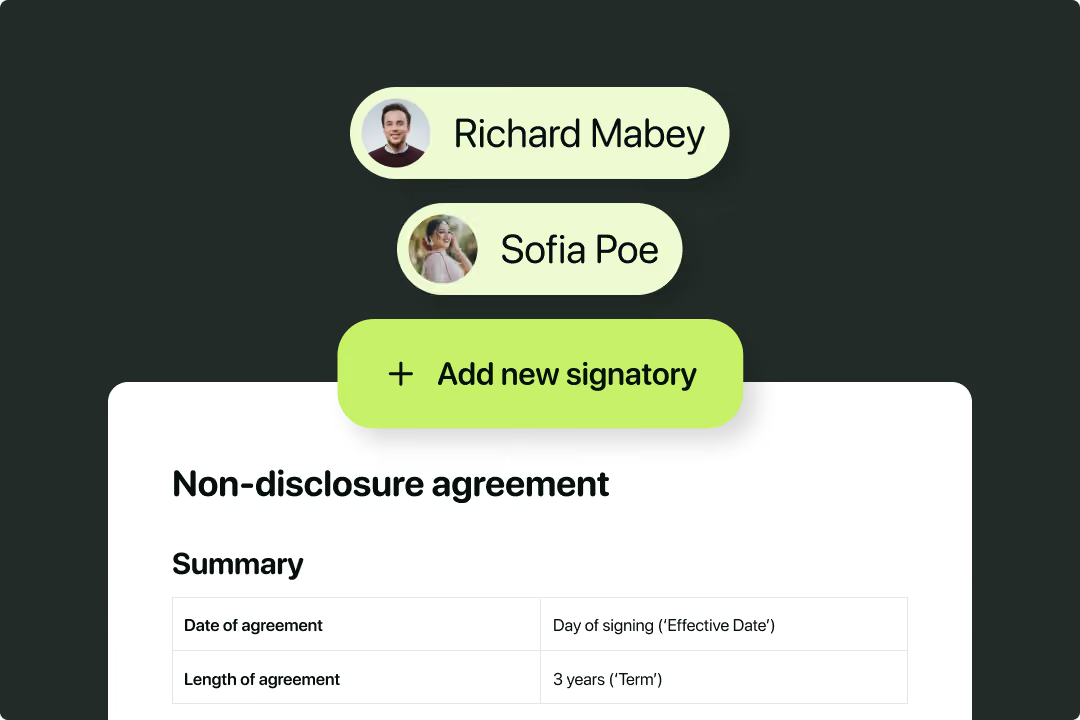
For finance teams, this is what the intelligent repository is designed for: not just contract storage, but the visibility into payment obligations that makes it possible to manage them before they become problems.
If inconsistent payment terms are creating cash flow blind spots across your contract portfolio, Juro can help.
Book a demo to see how finance teams use Juro's intelligent repository and AI Extract to get full visibility into payment obligations — without the manual effort.

Net payment terms define how long a buyer has to pay an invoice after it's issued. "Net" refers to the full amount due. Net 30 payment terms mean the full invoice must be paid within 30 days; net 60 within 60 days, and so on.
Net 30 means the full invoice amount is due within 30 days of the invoice date (or another specified triggering event). It's the most common payment term in B2B commercial contracts.
In most contexts, they mean the same thing. "Net" specifies the total amount owed. However, if a contract uses "30 days" without defining the triggering event, ambiguity can arise about whether the clock starts from the invoice date, receipt date, or acceptance date.
It's an early payment discount: the buyer can deduct 2% from the invoice if they pay within 10 days. If they don't, the full amount is due within 30 days. It incentivizes faster payment without changing the standard net 30 due date.
Net 30 is the most widely used in B2B contracts across industries. Net 60 and net 90 become more common in large enterprise transactions and industries with longer operating cycles.
It depends on which side of the transaction you're on. Net 30 payment terms are better for suppliers needing faster cash. Net 60 payment terms are better for buyers wanting to hold cash longer. Most businesses negotiate based on their leverage in the relationship.
The contract should specify consequences, such as late payment interest, service suspension, or termination rights. In the UK, the Late Payment of Commercial Debts Act allows statutory interest to apply automatically on overdue B2B invoices, even without an explicit contractual provision.
Only by mutual agreement, typically through a formal amendment. Payment terms are a material term, and unilateral changes are unenforceable. Renewal points are often the most practical opportunity to renegotiate.
Manually, it requires reading every contract and recording the relevant clause, which is slow and error-prone. AI-powered contract tools like Juro can extract payment term data from signed agreements automatically and surface it in searchable, reportable form.
Lorem ipsum dolor sit amet, consectetur adipiscing elit. Suspendisse varius enim in eros elementum tristique. Duis cursus, mi quis viverra ornare, eros dolor interdum nulla, ut commodo diam libero vitae erat. Aenean faucibus nibh et justo cursus id rutrum lorem imperdiet. Nunc ut sem vitae risus tristique posuere.


Hello. We are Juro Online Limited (known by humans as Juro). Here's a summary of how we protect your data and respect your privacy.