


.svg)

.svg)
.svg)

🇺🇸 22 Boston Wharf Rd, Boston, MA 02210
🇬🇧 2 Pear Tree Court, London EC1R 0DS
© 2026, Juro. All rights reserved.


🇺🇸 22 Boston Wharf Rd, Boston, MA 02210
🇬🇧 2 Pear Tree Court, London EC1R 0DS
© 2026, Juro. All rights reserved.

Picture this: your largest SaaS vendor auto-renews for another year because nobody flagged the 60-day notice window. That is $120,000 of unplanned spend, approved by nobody, committed by default. It happens more often than most finance teams would like to admit, and it is rarely a negotiation failure. It is a visibility failure.
Most finance teams don't own contract creation. Legal drafts. Legal negotiates. Legal signs off. But finance teams own what happens after signature: tracking payment obligations, monitoring renewal dates, pulling data for audits, flagging covenant breaches before they become defaults.
The contracts themselves are only part of the problem. The other part is managing them. This guide covers both: the main types of finance contracts, the key provisions inside each one, the challenges finance teams face in managing them, and how better finance contract management addresses each one.
The term "financial contract" covers any agreement that creates a financial obligation, right, or risk for a business. They govern the exchange of money, assets, services, or financial obligations, and create enforceable rights and duties for everyone involved.
In practice, the term covers most commercial agreements a business enters into. What makes a contract a "finance contract" is not a specific label but what it contains: payment terms, liability caps, indemnities, renewal conditions, and the consequences of failing to meet them.
Finance teams interact with these contracts primarily as post-signature stakeholders. That means they need to understand what the contracts say, where they are stored, and how to extract the information needed for reporting, forecasting, and compliance.

Vendor agreements govern the purchase of goods or services from third-party suppliers. They define what is being bought, at what price, under what payment terms, and what happens if either party fails to deliver.
Finance teams need to track payment schedules and ensure invoices match contracted terms, price escalation clauses that could affect budget forecasting, auto-renewal provisions that lock in spend if not cancelled within a notice window, and liability caps that set a ceiling on recoverable losses if a supplier underperforms.
Large vendor agreements may carry SOX implications if the goods or services are material to financial reporting, and GDPR obligations if personal data is processed under the contract.
POs are issued by a buyer to a supplier to authorize a specific purchase. They become legally binding once accepted and form part of the overall procurement paper trail alongside the vendor agreement or MSA.
Finance teams use POs to control and record committed spend, match invoices against approved purchases, and maintain an audit trail for accounts payable. Where a vendor agreement exists, POs should reflect the payment terms and pricing already agreed under that contract.
SaaS contracts are a growing share of most companies' committed spend. They combine elements of a service agreement and a software licence, with subscription fees paid in advance and access rights that expire on termination.
The provisions that create the most risk for finance teams are auto-renewal clauses (often requiring 30 to 90 days' notice to cancel), price uplift provisions on renewal, usage-based billing that can cause actual spend to diverge from budgeted spend, and data portability rights on termination.
SaaS contracts typically include a data processing agreement (DPA) as a schedule, which may need updating if the scope of data processing changes at renewal.
Loan agreements set out the terms on which a lender advances funds to a borrower. For businesses, these range from revolving credit facilities to term loans to asset finance arrangements.
The provisions that require closest finance team attention are financial covenants (ratios the business must maintain, such as a minimum debt-service coverage ratio or maximum leverage), drawdown conditions and timelines, interest rate mechanics (fixed vs. variable, and any hedging arrangements), repayment schedules, and events of default that could accelerate repayment or trigger penalty interest.
Compliance context: listed companies and regulated businesses may face additional disclosure requirements under FCA rules (UK) or SEC requirements (US). Material loan agreements typically require disclosure in financial statements. Verify specific thresholds with a subject-matter expert.
NDAs are often treated as low-stakes paperwork. In practice, they can carry significant financial exposure, particularly when they are part of an M&A process, a fundraising round, or a major partnership negotiation.
Key provisions that matter to finance teams include the definition of confidential information (which should cover financial data, forecasts, and business plans), survival clauses that extend obligations past termination, and any liquidated damages provisions for breach.
NDAs also interact with contract due diligence processes: finance teams are typically responsible for assembling the financial data room, and understanding what NDA protections are in place for that material matters.
Employment contracts define the financial relationship between employer and employee: base salary, bonus entitlements, equity vesting schedules, commission structures, and termination payments.
Finance teams need to monitor bonus trigger conditions and accrual timing, LTIP vesting schedules, garden leave clauses, and clawback provisions on prior-period bonuses. Listed companies and financial services firms may face additional requirements under FCA remuneration rules or SEC executive compensation disclosure obligations.
Leases for office space, equipment, and vehicles create ongoing payment obligations that don't manage themselves.
Finance teams need clear visibility into start and end dates, payment schedules, and renewal and termination options — because a lease that auto-renews for a further three years because no one actioned the break option is a real and avoidable cost.
Insurance policies are contracts in which an insurer agrees to compensate the insured against specified losses in return for a premium. For finance teams, insurance contracts represent both a cost to manage and a risk management tool to understand. Key provisions include coverage limits and exclusions, premium payment schedules, renewal terms, and claims procedures.
Finance teams should maintain a clear inventory of active policies, the risks they cover, and their renewal dates. An insurance gap discovered after an incident is significantly more expensive than one caught at renewal.
For more on this, check out our guide to insurance contract management.
Investment agreements govern the terms on which equity or debt capital is invested in a business. For growth-stage companies, these typically include term sheets, shareholders' agreements, subscription agreements, and convertible loan notes.
Finance teams need to understand provisions around liquidation preference (which determines payout order on exit and affects how exits are modelled), anti-dilution protections, information rights that require periodic financial reporting to investors, and any financial covenants attached to the investment.
These contracts often interact with other commercial agreements: certain transactions may require investor consent under reserved matters clauses, and drag-along rights may affect how acquisitions are structured.
Standalone bonus and incentive plans sit alongside employment contracts and govern performance-linked pay. Finance teams are typically responsible for modelling accruals, tracking eligibility and payout triggers, and ensuring clawback provisions are enforced where applicable in commission agreements.
The tax treatment of different incentive structures, particularly equity-settled schemes, requires careful coordination between finance and legal.
SLAs define the performance standards a vendor or service provider must meet, including uptime commitments, response times, and penalty structures for non-compliance.
For finance teams, SLAs matter because penalty credits or service failure events can trigger financial adjustments that need to be reflected in accounts payable and accruals.

Poor finance contract management is not an abstract risk. It's often a tangible, measurable one that shows up in the P&L:
Beyond direct cost, inefficient finance contract management slows the business down. Consider an M&A process where the acquirer requests a complete contract schedule during due diligence.
If contracts are scattered across three shared drives, two email inboxes, and a filing cabinet, assembling that schedule takes weeks, not days. It delays close, creates negotiating leverage for the other side, and burns significant internal resource. The same problem plays out at smaller scale every time a board pack is due or an auditor asks for documentation.
The common thread is visibility. Most finance contract management problems trace back to contracts that are hard to find, hard to read, or scattered across too many systems to track reliably.
Understanding the contract types is one part of the problem. Managing them effectively post-signature is the other.
When contracts are scattered across email threads, shared drives, and filing systems, basic questions take far too long to answer:
Without a centralized system, the only option is a slow, manual search through files, and that creates plenty of room for things to be missed.
Juro's intelligent repository brings every contract into one searchable place. AI Extract pulls key dates, payment terms, liability caps, and other provisions out of the document and into structured contract data.
And with Operator, finance teams can query that data instantly, running reports on their entire contract portfolio without opening individual files or waiting for legal to pull the information manually.
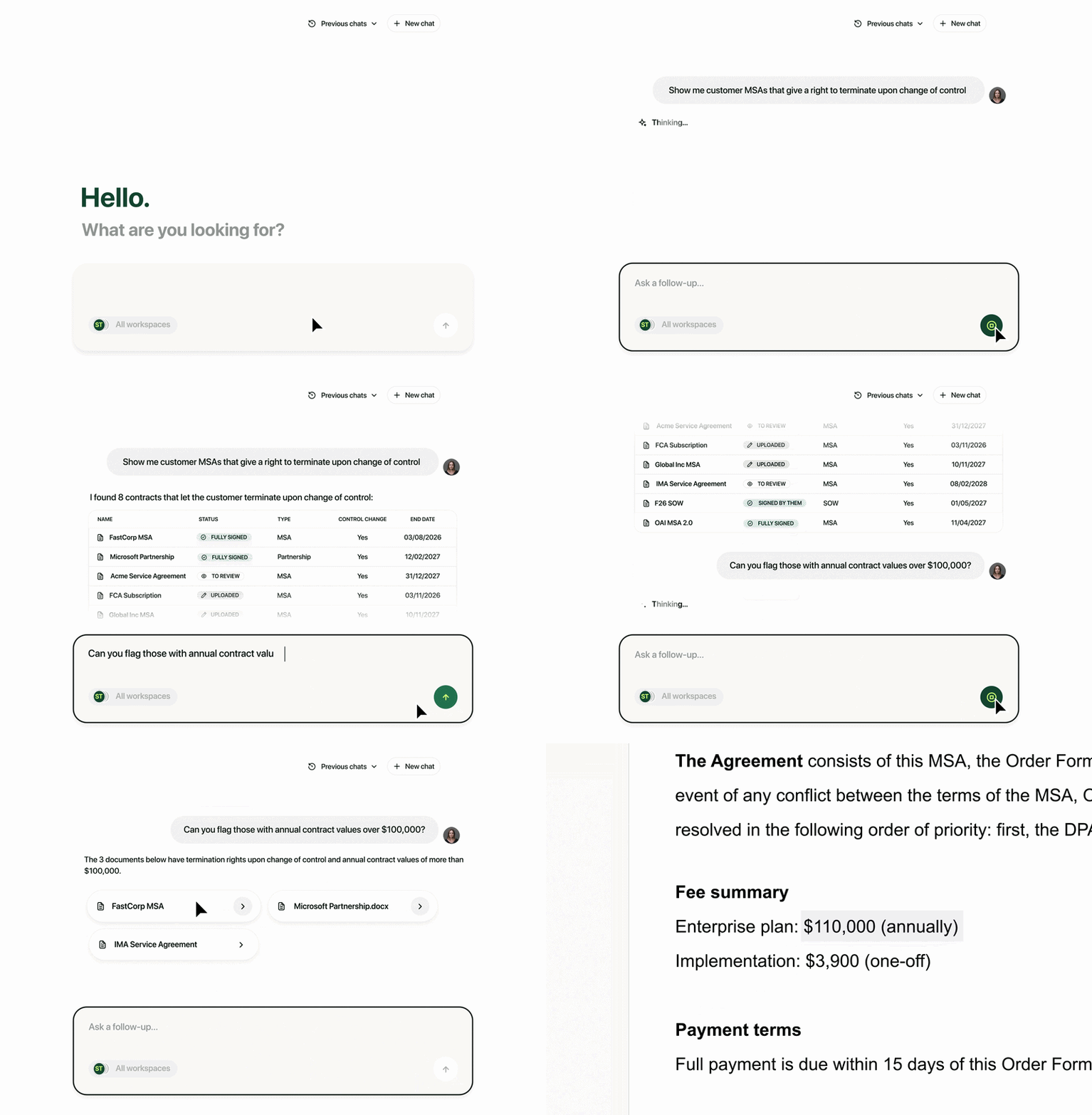
To see Operator live and in action, hit the button below to book your personalized demo.

Auto-renewal clauses are standard in SaaS and vendor agreements, and without a system that tracks notice windows and sends alerts ahead of deadlines, cancellation windows pass unnoticed and unplanned spend gets committed.
Juro's contract reminders flag upcoming auto-renewals before the notice window closes, giving finance teams enough time to make an informed decision about whether to renew, renegotiate, or cancel.
Investor reporting, board packs, audit requests, and M&A due diligence all require rapid assembly of contract data. When the only way to extract that data is reading through PDFs manually, those processes take longer than they should and carry a higher risk of error.
With Juro's Operator, finance teams can run instant reports on contract data without waiting for legal to pull the information. What would previously take days of manual work takes minutes.
When the same vendor agreement exists in three versions across three different folders, finance teams cannot be confident they are working from the right terms. Version control and a single source of truth are not optional.
Juro keeps a full audit trail of every contract, with a clear record of what was agreed, when, and by whom. Finance teams always know they are working from the executed version.
Finance teams often need to request contract information from legal, creating bottlenecks that slow reporting, forecasting, and decision-making.
Juro's contract permissions give finance teams direct read access to the contract repository, so they can find the information they need without routing every request through legal. Legal stays in control of the process; finance stops waiting in the queue.
If your contracts are currently scattered across shared drives, email threads, and spreadsheet trackers, the problem is not that your team isn't diligent. It is that the tools are not built for the job.
Juro is an AI-native contracting system built for lean legal and finance teams. The intelligent repository brings all contracts into one place, with AI Extract pulling key dates, payment terms, liability caps, and other provisions into searchable contract data.
Operator lets finance teams run instant reports across their entire contract portfolio. Renewal alerts flag upcoming auto-renewals before notice windows close. And user permissions give finance teams direct access to the contracts they need, without creating bottlenecks for legal.
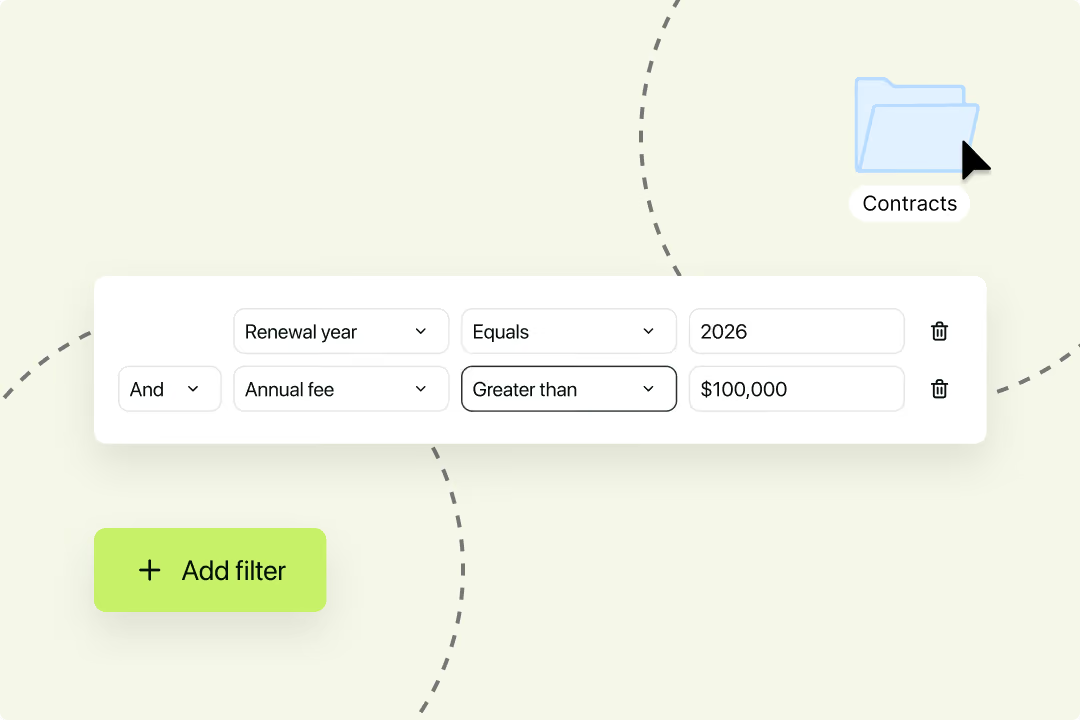
Finance teams at companies like Trustpilot and Deliveroo use Juro to reduce time spent on contract admin and improve visibility into commercial obligations, meaning faster audit preparation, fewer missed renewals, and cleaner data for forecasting. If that sounds like a better way to work, it is worth seeing for yourself. Book a personalized demo.
Finance contracts are legally binding agreements that create a financial obligation, right, or risk for a business. In practice, that covers most commercial agreements: vendor deals, SaaS subscriptions, loan facilities, leases, NDAs, employment contracts with financial terms, and investment agreements.
Poor finance contract management leads to missed auto-renewals that commit unplanned spend, undetected covenant breaches that trigger penalty clauses, overpayments where invoiced amounts no longer match contracted rates, and slower reporting and due diligence. The common cause is a lack of visibility into what contracts say and when key dates fall.
Responsibility typically sits with whoever owns financial reporting and spend visibility, often the CFO, VP of Finance, or a finance operations manager.
In practice, day-to-day contract management is shared: legal owns creation and negotiation, procurement owns vendor relationships, and finance owns the post-signature obligations: payment tracking, renewal monitoring, covenant compliance, and reporting.
In lean teams without dedicated legal ops, finance often ends up covering all of these. The clearest way to avoid gaps is to define ownership by contract type and ensure each type has a named owner responsible for key dates and obligations.
Missed obligations are the most common source of avoidable cost: auto-renewals not cancelled in time, covenant breaches not flagged early enough, and reporting deadlines missed because contract data was not accessible. Centralized storage and automated alerts address the majority of these.
Contract lifecycle management (CLM) software provides a centralized repository for contracts, tools for extracting and reporting on contract data, and automated alerts for key dates. For finance teams, it reduces manual tracking work, improves audit readiness, and gives faster access to the contract information needed for reporting and decision-making.
Lorem ipsum dolor sit amet, consectetur adipiscing elit. Suspendisse varius enim in eros elementum tristique. Duis cursus, mi quis viverra ornare, eros dolor interdum nulla, ut commodo diam libero vitae erat. Aenean faucibus nibh et justo cursus id rutrum lorem imperdiet. Nunc ut sem vitae risus tristique posuere.


Hello. We are Juro Online Limited (known by humans as Juro). Here's a summary of how we protect your data and respect your privacy.