Explore contract lifecycle management software use cases, benefits and recommendations for 2026 in this deep-dive.
Key takeaways
CLM has matured: it’s no longer just storage and eSignature, it’s a full workflow + intelligence engine for contracts.
You should evaluate CLM tools by: speed to value, adoption by business teams, data integration, and AI readiness — not just feature-lists.
The right CLM becomes a strategic platform, promising faster deals, better compliance, real-time visibility, and fewer manual bottlenecks.
Contracts are the connective tissue of every business — they define how revenue is captured, how suppliers are managed, and how teams stay compliant. But in too many organisations, contracting remains fragmented: Word files live in email threads, signatures sit in a separate app, and no one can say for sure which version is final.
That’s what established contract lifecycle management (CLM) software as a strategic priority for every growing company. The advent of generative AI has driven improvements in CLM, such that in 2026, the best CLM platforms don’t just store contracts — they run the contracting process from end to end, combining automation, data, and collaboration in a single system.
What is contract lifecycle management software?
Contract lifecycle management software is a tool that enables legal and commercial teams to streamline, automate, and speed up the management of contracts throughout their lifecycle.
CLM systems deliver value at every stage of the contract lifecycle, covering contract creation, review, negotiation, approvals, signing, storing, tracking and renewals. And in 2026, those systems incorporate AI, not as an add-on, but as a core component, to accelerate valuable outcomes for legal teams.
For legal teams, CLM is about control. For everyone else, it’s about speed. And in 2026, both matter more than ever.
Sales teams can’t afford delays waiting for legal to draft a contract. Talent teams need to issue offer letters in hours, not days. Finance needs visibility into obligations and renewals without chasing spreadsheets.
A modern CLM platform addresses all three problems at once — and that’s why adoption is accelerating.
Faster contracting: Templates and automation replace manual drafting.
Fewer errors: Version control and approval workflows ensure only pre-approved language is used.
Data visibility: Every agreement becomes searchable and reportable.
Scalability: Lean legal teams can support high growth without extra headcount.
To understand what CLM actually does, it helps to walk through a typical contract journey.
Creation – A user selects a pre-approved template and answers a few questions. The system populates the document automatically, pulling data from CRM, HR, or procurement tools.
Review and negotiation – Comments and redlines happen live, in one browser-based version. Internal and external teams can collaborate without juggling attachments.
Approval – Built-in workflows ensure contracts above a certain value, or with specific clauses, are automatically sent to the right reviewer.
Signature – Native eSignature finalises the agreement securely and instantly.
Storage and search – The executed contract lives in a central contract repository, fully searchable and linked to related documents.
Tracking and renewal – Automated reminders surface deadlines, renewals, and obligations before they’re missed.
Reporting – Dashboards reveal contract values, cycle times, and compliance metrics in real time.
Take a look at this demo of Operator by Juro to see how AI-native CLM can unlock contract data:
At each stage, CLM software removes manual effort and human error, while keeping legal in control of the playbook.
If this sounds like something that would benefit your business, hit the button below to find out more. To compare contract lifecycle management software vendors and use cases, read on.
They put contracts on autopilot. You can too.
Whether it’s your CRM, communication platform, AI Assistant, or somewhere more exotic, Juro enables contracting to happen anywhere - right where your colleagues already work.
How are businesses benefitting from contract lifecycle management software today?
1. A simplified, seamless tech stack for contracting
For many businesses, the contract lifecycle is a fragmented, slow, and inefficient process.
Contracts are drafted in Microsoft Word, shared via email, signed in eSignature tools, stored in shared drives, and eventually tracked in Excel spreadsheets.
This means that companies rely on up to six different tools to manage their contracts, and moving back and forth between these different platforms results in friction and data loss.
A CLM solution like Juro transforms this process, enabling your team to trade a chaotic contracting tech stack for a single, unified workspace where contracts are managed end-to-end.
For Tibber, this transition didn’t just welcome a more frictionless process. It also saved the business money in the long-run by reducing unnecessary tooling:
{{quote1}}
2. Contract data at your fingertips when you need it
Another benefit of CLM software is that it captures key data from contracts throughout their lifecycle. You can monitor everything from your contract values to risk exposure, upcoming contract milestones, and compliance.
This makes it easier than ever to record, track, report on, and analyze these metrics for internal and external purposes, like fundraises, for example:
{{quote2}}
While exciting, these big events can already put legal teams under pressure, with plenty of strategic and compliance work to pick up.
Having to find, aggregate, and manually extract data from all of your contracts in the process can be avoided easily by adopting a contract lifecycle management tool like Juro:
{{quote3}}
3. Better collaboration between contract stakeholders
Contract collaboration is often painful when it happens in several different places simultaneously.
Redlines fall through the cracks of email inboxes, tracked changes are lost when new versions are created, commercial teams drop time-sensitive requests on legal teams via Slack or Teams.
Contract lifecycle management software facilitates conversations and negotiations by providing a single workspace for comments, approvals and redlines. Juro users can even automate workflows so that only high-value contracts, or those that meet certain criteria require intervention from senior management.
With a CLM system in place, you can track the progress of a contract in real time, with a detailed audit trail of the actions that have taken place - and those blocking the agreement from getting over the line.
In fact, our State of In-house Report 2024 found that lawyers are 1.5x more likely to feel friction with sales team when they don't have a CLM solution in place. Juro solves for this.
Who uses CLM software?
CLM software is typically used by legal and commercial teams in businesses that process a high volume of routine contracts and can benefit from legal automation.
In particular, legal teams use CLM software to streamline day-to-day contracting and enable other business teams to automate routine contracts in a safe and controlled way. This, in turn, frees up legal's time, enabling them to work on higher-value projects and upskill in new areas.
But it isn't just legal teams that can benefit from CLM tools like Juro. A solution like Juro can also be used to enable and improve processes for other teams in the business.
Sales teams use CLM software to get sales agreements created and agreed faster, without having to leave their CRM
Finance and ops teams use contract lifecycle management tools to maintain visibility into contracts and minimize contract value leakage
HR teams use CLM software to automate routine contract workflows, from updating employee contracts at scale to ensuring compliance with laws and pre-approved terms
Procurement teams can use contract lifecycle management software to negotiate more favourable terms with their suppliers and making monitoring vendor relationships simple
Contract lifecycle management features to look out for
The contract lifecycle management features you need typically depend on the work you're doing, and which areas you can optimize your current process to increase efficiency. However, most businesses will benefit from the following CLM features:
Rich-text contract editor
Automated contract templates
Approval workflows
Split internal and external versions
Browser-based redlining
Advanced eSignature functionality
Secure contract repository
Automated contract reminders
Customizable contract dashboard
Contract intelligence and reporting
Integrations with other business platforms
Detailed contract audit trails
Native AI functionality (e.g contract drafting, review, and extraction)
As we mentioned, every business will have different CLM requirements, so you should scope out exactly what you need from a platform and evaluate them accordingly.
What is the best contract lifecycle management software for 2026?
There are plenty of contract lifecycle management solutions on the market, each with a different set of features, benefits and limitations. To make your vendor research that bit easier, we've compiled a list of the best contract lifecycle management software in 2026, with a list of benefits and limitations of each shared by real, verified users.
1. Juro: best CLM overall for legal and business teams
Also known as intelligent contract automation, Juro is an evolution of contract lifecycle management software. It empowers scaling businesses to create, agree, execute and manage contracts up to 10x faster than traditional tools.
Juro is the only platform specifically designed to work for both legal and commercial teams, resulting in faster contracting cycles, lower costs and reduced risk across the business. Juro is also highly flexible, meaning it is fast to implement and easy to maintain.
Benefits of Juro
Benefits
What do real users say?
Self-serve workflows and templates
"Juro has really helped our legal department become more agile and provide
self-serve options for other teams within the company"
– G2 review
Simple and intuitive user interface
"The user interface is clean, intuitive, and not overwhelming, making it
easy to navigate even for those who are not tech-savvy. This simplicity,
however, does not compromise its robustness"
– G2 review
Loved by all teams in the business
"Juro is the first CLM I've encountered that has truly been adopted (and
enjoyed) by various company departments/stakeholders"
– G2 review
Quick and easy implementation
"I ran a 30 minute training session with the sales and customer success
team on Friday and by Monday we had our first contract created, sent and
signed in Juro"
– G2 review
Seamless integrations with other business platforms
"My favorite part about Juro is the seamless integration with Salesforce.
Our staff lives and breathes Salesforce so providing them with a feature
in a platform that they are already familiar with was paramount"
– G2 review
Top-rated customer support
"Another thing I love about Juro is how the team is always eager to
support us in our projects. Their responses are always quick, and they go
above and beyond by teaching us how to maximize productivity in Juro"
– G2 review
Limitations of Juro
Limitations
What do real users say?
Lacking some foldering functionality
"In the future, we hope to see a more complex filing structure,
improvements in the mechanism for handling attachments, and more direct
linkages between related contracts"
– G2 review
The third party paper workflows are a new feature
"More options to upload and negotiate third party contract templates
which I understand is in development"
– G2 review
Doesn't solve fears around eSigning
"Not all companies trust or use electronic signatures even in 2024.
It can be difficult to encourage third party use"
– G2 review
Limited flexibility around reminders
"I'd like some more flexibility around reminders and when the
notifications are sent would be great but there are workarounds for this"
– G2 review
Who is this CLM best for?
Juro is the best contract lifecycle management software for legal and commercial teams in scaling businesses with large contract volumes. Unlike most contract lifecycle management solutions, Juro was designed for both legal and business teams, enabling them to:
Agree and manage contracts end-to-end in one collaborative workspace
Accelerate contract drafting and collaboration with AI to shorten contract lifecycles
According to independent reviews in 2026, Juro is the CLM platform with the highest user adoption, as well as being the most implementable contract platform on the market. Find out more here.
Juro powers millions of contracts for the world's fastest-growing businesses, including companies like Trustpilot, Granola, On Running, Deliveroo and many more. To find out more about how Juro could work for your business, book a demo today.
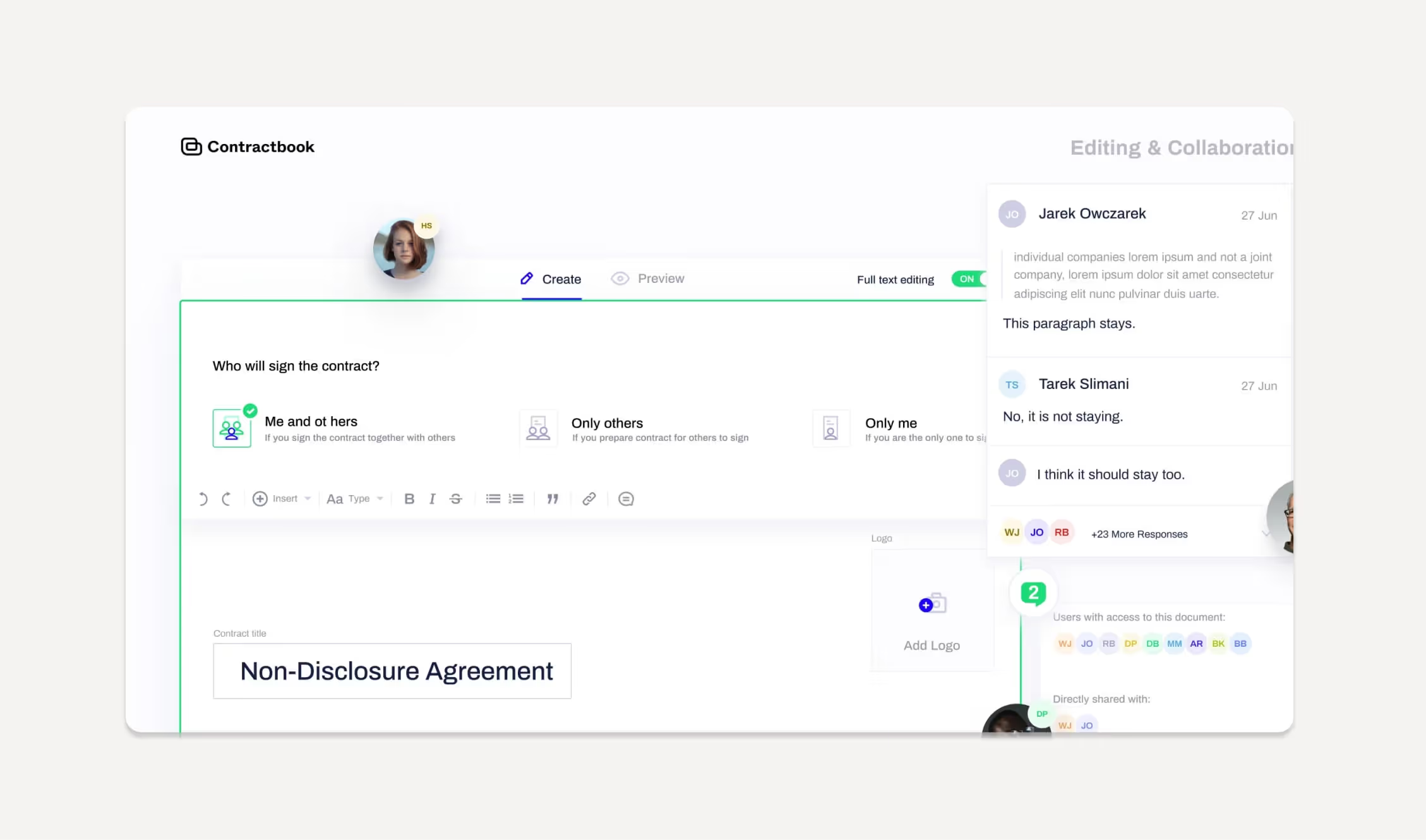
2. Contractbook: best CLM for small sales and operations teams
Contractbook is a popular contract management solution that works well for small sales and operations teams processing some standard contracts, and storing signed PDFs.
The main value area for users is the post-signature contract management functionality. It offers the features you need to filter, search, sort, and organize contracts. It also embeds AI in these workflows - like Juro.
Contractbook does also offer some limited pre-signature contract management features, and a native electronic signature solution.
However, these aren’t as comprehensive as those offered by Juro, and these limitations mean that Contractbook might lack the more nuanced functionality that legal teams need to set conditions and retain control of contracts across the business.
Contractbook's collaboration functionality
Benefits of Contractbook
Benefits
What do real users say?
Provides visibility into contract data
"We are able to see expiration dates and quickly know when an agreement is coming up for renewal"
– G2 review
User-friendly interface
"Its user-friendly interface and streamlined workflow make it effortless to create and sign individual documents, while also guiding you through the entire contract cycle"
– G2 review
Integrations with CRMs
"I think the best part is the integrations, especially with our current CRM. The workflows and integrations come across as very intuitive and streamlined"
– G2 review
Positive experiences with customer support
"No matter the request I have the employees have always been extremely helpful and find ways to make it work"
– G2 review
Limitations of Contractbook
Limitations
What do real users say?
Reports of misaligned expectations
"If we had had a better introduction meeting, we would have spent less than six months setting up how Contractbook would work better for us. We were to the point of not moving forward"
- G2 review
Some bugs and errors that require manual work to fix
"There are bugs and stuff that require manual/extra work, e.g. having to refresh contracts before sending them, pop-ups about using same email twice (even while not doing that), overall lagginess of the page, customers having trouble signing"
- G2 review
Lacks redlining and real-time negotiation functionality
"Would be great if there was a red-line version to track edits and changes on some larger contracts"
- G2 review
Core features are locked behind premium plans
"The database feature is a premium-level feature, and that's one of the essential tools an in-house legal person needs"
- G2 review
Expensive for small businesses
"It's pretty expensive, especially if you need more seats or features like automations. So it might not be suitable for startups or smaller SMBs"
- G2 review
Who is this CLM best for?
This CLM solution is best-suited to small sales and revenue operations teams that want to store and monitor commercial agreements at scale.
It’s particularly useful for those that want to integrate contracts with their CRMs to streamline processes, but it’s less useful for complex legal documents that require more back-and-forth between parties.
3. SAP Ariba Contracts: best CLM for sourcing, invoicing and procurement needs
SAP Ariba Contracts is a CLM solution that enables procurement and sales teams to create and agree contracts in a more consistent way. This contract lifecycle management software specializes in post-signature contract workflows, with powerful reporting functionality and the ability to monitor spend history and compliance in real time.
Since SAP Ariba also offers sourcing, invoicing, and payment processing functionality, this contract lifecycle management software is a good fit for enterprise businesses that have complex procurement requirements.
SAP Ariba's contract analytics functionality
Benefits of SAP Ariba
Benefits
What do real users say?
End-to-end procurement functionality
"Ariba covers the entire procurement process, from requisition and sourcing to invoicing and payment" - G2 review
Offers billing functionality
"SAP Ariba is an excellent product for procurement because it simplifies the purchases, approvals and billings" - G2 review
Supports with supply chain management
"The platform offers features for supplier onboarding, performance evaluation, and collaboration. This fosters better relationships with suppliers" - G2 review
Easy to use and adopt
"I absolutely love how the UI of SAP Ariba is so simple and easy to implement. With the introduction of CIG, implementation has been so smooth" - G2 review
Strong and recognized reputation
"SAP is a well-known tool used in financial accounting, controlling, sales and distribution" - G2 review
Limitations of SAP ARIBA
Limitations
What do real users say?
Steep learning curve for users
"You are going to have a slightly difficult learning curve for few initial days. The UI is not exactly a user friendly one and can be difficult to navigate" - G2 review
Reports of slow or laggy performance
"SAP Ariba is extremely slow and laggy, and also the UI/UX is average" - G2 review
Pricing is expensive and often unaffordable for small businesses
"The subscription cost of SAP Ariba can be high for smaller size businesses" - G2 review
Customization options are limited
"Not every business will find SAP Ariba to be the best option, especially if they have specific demands that call for a great deal of customization or have limited resources" - G2 review
Integrations can be difficult or costly to configure
"Integrating SAP Ariba with existing enterprise systems can be complex and require additional investment" - G2 review
Who is this CLM best for?
SAP Ariba’s contract lifecycle management solution is best suited to large businesses that are willing to compromise ease for functionality. It works for procurement teams in large corporate environments as it can support other tasks, like sourcing and invoicing. However, it is less suitable for legal and commercial teams in scaling businesses that want a tool that's flexible and easy to use.
4. Icertis: best CLM for businesses seeking a repository and reporting tool
Icertis is another CLM platform that focuses on post-signature contract management and integrates seamlessly with ERP and spend management systems.
Icertis’ strongest functionality is its contract repository and reporting capabilities, with many users recognizing the CLM tool as a contract intelligence platform. This is what makes it a popular choice for businesses that need a firm grasp on governance and compliance.
Icertis' contract compliance system
Benefits of Icertis
Benefits
What do real users say?
Breadth of features available
"Icertis is a complete package which caters to end to end CLM right from build to execution" - Capterra review
Useful Microsoft Word plug-in
"Icertis' Word plug-in is incredibly useful when configuring clauses and templates. I enjoy how simple it is to configure these entities" - Gartner review
Great customization options for complex workflows
"Icertis adapted well to some of our specific needs. Workflows for approvals specific to our needs is a huge win for us in this system" - G2 review
Customizations can be difficult to self-serve with
"The software is very helpful in finding and reporting on key attributes in the legacy contracts" - G2 review
Well-integrated with other key business systems
"It comes ready with multiple integrations to large platforms like, SalesForce, Adobe, SAP, necessary for any contract lifecycle management software" - G2 review
Limitations of Icertis
Limitations
What do real users say?
User interface is dated and unintuitive
The user interface of the application itself leaves something to be desired. It's possibly one of the worst modern SaaS applications I've seen in this regard - G2 review
Negative implementation experiences
"Icertis need to work on the implementation side. It was not a very pleasant experience working with the Icertis implementation partner" - G2 review
Can be unreliable at times
"I have a lack of confidence uploading and downloading documents and retaining changes. It seems to have a mind of its own pulling previous document versions" - G2 review
Customizations can be difficult to self-serve with
"Though the vendor is flexible and allowed us to customize as we want, the customizations were a pain to maintain during the upgrade process" - G2 review
Reports of the software being slow or unresponsive
"The software can be slow and unresponsive, causing delays and making it harder to manage contracts. It also doesn't work well with other systems" - Capterra review
Who is this CLM best for?
Given the CLM platform’s emphasis on governance and compliance, Icertis is most suitable for enterprise companies with strict regulatory requirements. It’s also a good option for businesses with more complex contract processes and requirements because it is highly customizable. However, due to its complexity, this CLM software is less suitable for businesses that want to automate routine contracts and want to get to value quickly.
5. Agiloft: best CLM for enterprise-grade businesses with complex requirements
Agiloft is one of the oldest contract lifecycle management tools on the market, renowned for its enterprise-grade features and security. Like most legacy CLM systems, Agiloft is highly customizable, with plenty of features for users to take advantage of. Agiloft’s customers include Moderna, Chevron and Taylormade to name a few.
Agiloft's contract approval workflow setup
Benefits of Agiloft
Benefits
What do real users say?
Integrations with billing systems
"The best feature is that fact that we were able to integrate with our billing system so that once a contract is executed, it can create the billing and send it to our billing system, rather than having it missed or manually entered" - G2 review
Highly customizable
"What I really like is how you can customize basically everything. We’ve managed to set it up to fit exactly what our team needs, which is great" - G2 review
Offers conditional logic
"We can select various terms and conditions and the system will recognize which clauses need to go in the agreement based on the selection to populate a complex agreement that would otherwise take hours" - G2 review
Robust access controls
"[Agiloft's] robust access permissions enable tight control over access to data" - G2 review
Limitations of Agiloft
Limitations
What do real users say?
Challenging to customize and configure
"Some custom configurations are a bit tricky to learn, and require manual, repetitive tasks to properly implement" - G2 review
Long implementation periods
"I would recommend allocating a significant budget for a good Agiloft project manager and implementation team to support you through the process" - G2 review
Limited reporting capabilities
"The system works great as a contract management system, but capturing key performance indicators via data was a challenge" - G2 review
Not as user-friendly as other options
"The user interface could be more updated and visually appealing for non tech users" - G2 review
Who is this CLM best for?
Agiloft is most suitable for businesses that require a high level of configurability, with the platform offering an extensive set of features. However, independent reviews suggest that this level of configuration requires a lot of technical expertise and time to use and implement. This makes it a weaker solution for businesses without these resources in place.
What to consider when choosing CLM software
When it comes to choosing the right CLM software for your business, there are a few things you need to consider:
Workflow coverage. Which stages of the contract lifecycle are most painful for you currently? How does each CLM platform deliver value at this particular stage? Are any core features missing?
How complex your contracts are. Are you tackling standard agreements that require consistency, or do you manage contracts that are heavily negotiated? How well does each contract lifecycle management system accommodate these types of contracts?
Budget. What budget have you been allocated for a CLM tool? Will there be any additional fees for onboarding? Does user-based pricing work out too expensive for your team? Will you require any additional, separate tools still?
Required integrations. Which other business platforms would you like to integrate with your CLM software? Are these integrations available in all other tools? If they are, are they effective and affordable?
Implementation periods. How quickly do you need to receive value from this tool? Do you have the time and resources required to invest in a heavy CLM implementation? Are you looking for a lighter, out-of-the-box solution?
Need a CLM system that’s easy to use and implement?
Juro helps teams agree and manage contracts up to 10x faster by bringing legal and business users together in one collaborative workspace.
It’s trusted by thousands of companies — from Deliveroo to Remote — and powers millions of contracts globally.
Teams choose Juro because it’s:
Fast to implement
Easy for anyone to use
Flexible enough for complex legal workflows
Backed by world-class customer support
Juro is very easy to use amongst lawyers and non-lawyers! Many different teams within our business benefit from Juro - Verified Juro user, G2 review
Juro is the first CLM I've encountered that has truly been adopted (and enjoyed) by various company departments/stakeholders - Verified Juro user, G2 review
Juro is trusted by 6000+ of the world's leading companies and is one of the top-rated contract lifecycle management platforms according to G2. Book a personalised demo to see how Juro can transform the way your teams agree, execute and manage contracts.
Sofia Tyson is the Senior Content Manager at Juro, where she has spent years as a legal content strategist and writer, specializing in legal tech and contract management.
Sofia has a Bachelor of Laws (LLB) from the University of Leeds School of Law where she studied the intersection of law and technology in detail and received the Hughes Discretionary Award for outstanding performance. Following her degree, Sofia's legal research on GDPR consent requirements was published in established law journals and hosted on HeinOnline, and she has spent the last five years researching and writing about contract processes and technology.
Before joining Juro, Sofia gained hands-on experience through short work placements at leading international law firms, including Allen & Overy. She also completed the Sutton Trust’s Pathways to Law and Pathways to Law Plus programs over the course of five years, building a deep understanding of the legal landscape and completing pro-bono legal volunteering.
Sofia is passionate about making the legal profession more accessible, and she has appeared in several publications discussing alternative legal careers.
Lorem ipsum dolor sit amet, consectetur adipiscing elit. Suspendisse varius enim in eros elementum tristique. Duis cursus, mi quis viverra ornare, eros dolor interdum nulla, ut commodo diam libero vitae erat. Aenean faucibus nibh et justo cursus id rutrum lorem imperdiet. Nunc ut sem vitae risus tristique posuere.
Your privacy at a glance
Hello. We are Juro Online Limited (known by humans as Juro). Here's a summary of how we protect your data and respect your privacy.
“We saved $8000 a year having cancelled our subscription to the eSigning platform - Juro has a native eSignature, and covers the pre- and post- signature stages. That’s the biggest return on investment”
Ulrika Leikvang, Head of Legal at Tibber
“In a few clicks, the contracts are saved in one place, and we derisk in terms of data management and keeping track of our legal documents. When you’re pulling together a data room for a fundraise, this is invaluable”
Clio Anderson Garwood, Senior Legal Counsel at Paddle
“When contracts were spread across up to six different tools, there was no way to measure the time spent at different stages. With Juro, we’ve consolidated the process and now have structured data to give us these insights”
Davis Troutman, Product Product Manager at Placemakr




.svg)

.svg)
.svg)






.avif)