





.svg)

.svg)
.svg)

🇺🇸 22 Boston Wharf Rd, Boston, MA 02210
🇬🇧 2 Pear Tree Court, London EC1R 0DS
© 2026, Juro. All rights reserved.


🇺🇸 22 Boston Wharf Rd, Boston, MA 02210
🇬🇧 2 Pear Tree Court, London EC1R 0DS
© 2026, Juro. All rights reserved.

Of all the relationships in a business, finance and legal tend to be among the closest.
Both teams are focused on protecting the company, managing risk, and keeping the business on solid ground. They often report into the same leadership, work on the same deals, and share a mutual respect for rigor and process.
But when it comes to financial contracts, that natural alignment often breaks down. Not because finance and legal are at odds, but because the tools and processes most companies rely on were never designed to support both teams working together.
Contracts travel over email, get reviewed in Word, and then are tracked in spreadsheets. Somewhere in that process, the workflow breaks down and communication follows.
This article looks at where those breakdowns happen, what genuinely collaborative finance-legal contract management looks like, and how to build the processes and tooling to get there.
Most companies have no shared system for managing contracts. Finance works from spreadsheets, legal works from shared drives, and neither has visibility into what the other is doing.
The consequences of this can be costly:
Contract approvals often require input from both teams, but in many businesses, there’s no formal handoff process. Some approval requests are documented in Slack or Teams, others are assumed but never formally made.
As a result, commercial teams wait for approvals that were never requested, stalling deals and putting internal relationships under strain.
When contracts travel across email threads and shared drives, it becomes difficult to know which version is the most current. Finance might be revisiting contract payment terms in draft three, while legal has moved to draft five and has no oversight of these requests.
Contract redlines get lost, internal comments go unaddressed, and expensive mistakes get signed off without a second thought.
Finance needs to track contract renewal dates, payment schedules, and termination windows to manage spend and forecast effectively. Meanwhile, legal needs visibility into indemnities, liabilities, and compliance requirements.
When contracts are stored in inboxes or generic file systems, neither team can easily surface this information. They either spend hours trawling through shared drives for key information, or they neglect to track and monitor it altogether. Both come at a cost.
With so many stakeholders involved in the contract process, it’s easy to arrive at a point where nobody owns the full lifecycle, and so nobody is accountable when things go wrong.
This lack of accountability can amount to uncomfortable conversations between the legal and finance department when problems arise.
Good collaboration between finance and legal is not about eliminating friction entirely. Some review and negotiation is healthy. It is about removing the unnecessary friction: the chasing, the duplicate work, the surprises.
{{quote2}}
The starting point is agreeing on who does what. Both teams should be clear on their respective roles at each stage of the contract lifecycle. Legal owns template creation and review. Finance owns budget sign-off and renewal tracking.
But the important thing is that both teams know when and how the other gets involved, and that process is documented well enough to survive staff turnover and the edge cases that come up over time.
As Danielle Price, CFO at Duco, puts it:
{{quote1}}
Without it, contracts fall into the gap between teams. Nobody acts, or both teams act simultaneously. Either way, it comes at a cost.
The sections below cover the specific process and tooling decisions that make this work in practice.
Legal teams that operate as strategic partners rather than gatekeepers make finance's job significantly easier. That means going beyond reviewing contracts when asked, and actively designing the processes, resources, and data flows that finance depends on.
We sought advice from an expert in this field, Danielle Price, CFO at Duco, to hear what she thought legal teams could do to better enable finance departments:
Danielle Price is direct about what she looks for from her legal team: someone to "develop and design improved ways of working across the organization — standardizing documents or processes, delivering training, or producing cheat sheets."
For finance, this translates to pre-approved contract templates for routine vendor and supplier agreements, clear guidance on which contract terms are fixed and which are negotiable, and accessible reference materials that answer common questions without requiring a lawyer.
When finance can answer routine contract questions independently, legal's time is freed for higher-value work.
Price notes that at Duco, "legal and finance teams often work asynchronously in workstreams and as such have developed a very open dialogue across the teams." The key word there is dependencies.
Each team needs to understand not just their own role but where the other team is relying on them: which contract decisions affect financial forecasting, which approval delays have downstream budget consequences, and which obligations need to be flagged before they become a finance problem.
This kind of visibility does not emerge automatically. It requires deliberate communication habits, whether that is a standing touchpoint, a shared Slack channel for live contract questions, or a documented escalation path for contracts with financial complexity.
This is where legal has the most direct impact on finance's ability to forecast accurately.
Price puts it plainly: "if a contract contains something bespoke, that was negotiated and buried deep in the document, that could be a problem for sales ops and for finance, unless legal is proactive and transparent in bringing it to the right people's attention."
Non-standard payment terms, unusual renewal mechanics, or liability clauses that deviate from the template all have financial implications that finance cannot act on if they only find out after signature.
Legal's job is not just to negotiate and close the contract. It is to ensure the terms that affect the rest of the business are visible to the people who need them.
Better collaboration between finance and legal doesn’t happen by accident, and legal isn't solely responsible for making that relationship work. It requires deliberate process decisions, the right tooling, and a shared understanding of what the business is working towards.
Here are the practices that make the biggest difference:
Both teams should know who owns what at each stage before a specific contract creates pressure. In practice, that means documenting who initiates, who reviews, who approves, and who is responsible for tracking obligations after signature.
Without this clarity, contracts default to whoever is available rather than whoever is accountable, and things fall through the gaps.
Contract playbooks are a great way to codify those roles and responsibilities, but automating that playbook is the best way to ensure the contents of your playbook actually gets adopted.
Practical tip:
In Juro, legal can configure conditional approval logic so that contracts are automatically routed to finance when specific criteria are met: a contract value above a set threshold, payment terms beyond net 30, or a liability cap below a required minimum, for example.
That way, finance reviewers only see the contracts that are relevant to them, and the routing happens without anyone having to make a judgment call on the day or per contract.
It’s a reliable and efficient way to ensure consistency without the constant oversight from legal, and a great way to reduce risk by promising the relevant approvals at just the right time.
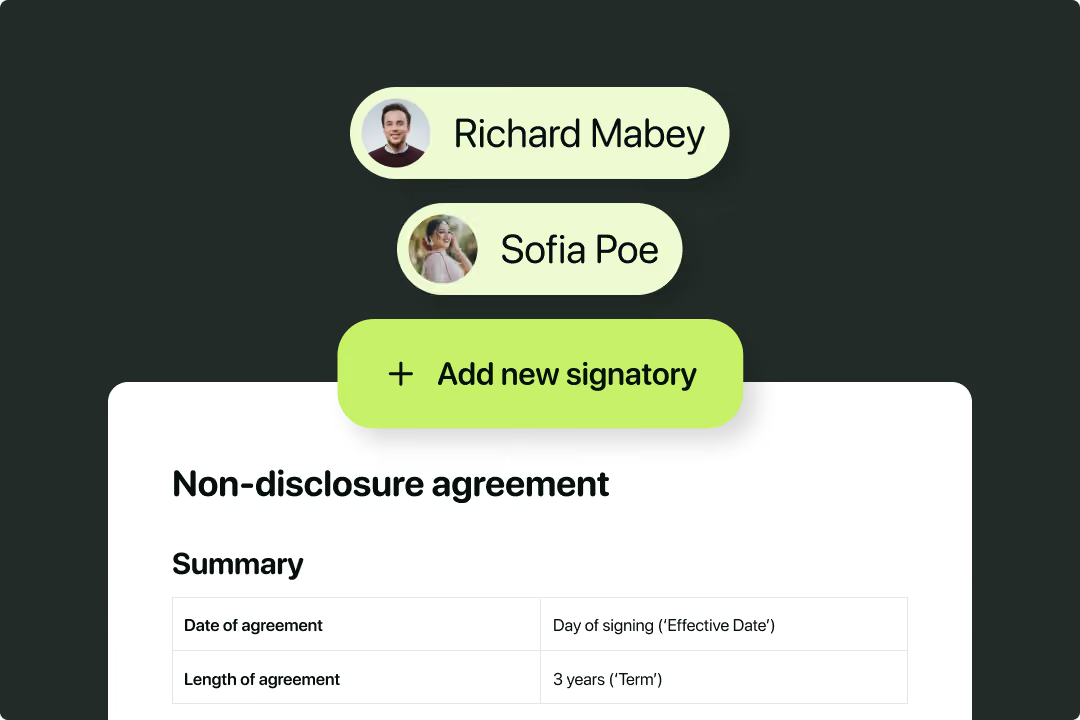
A documented approval process is only as good as the system enforcing it. When approvals rely on individuals remembering to forward documents or chase responses, the process breaks the moment someone is busy or out of office.
However, automating the chain removes that dependency entirely. Contracts move through the right sequence of reviewers automatically, with notifications sent, deadlines tracked, and every action recorded by default in a detailed contract audit trail.
The result is a process that is consistent regardless of who is handling it.
Practical tip:
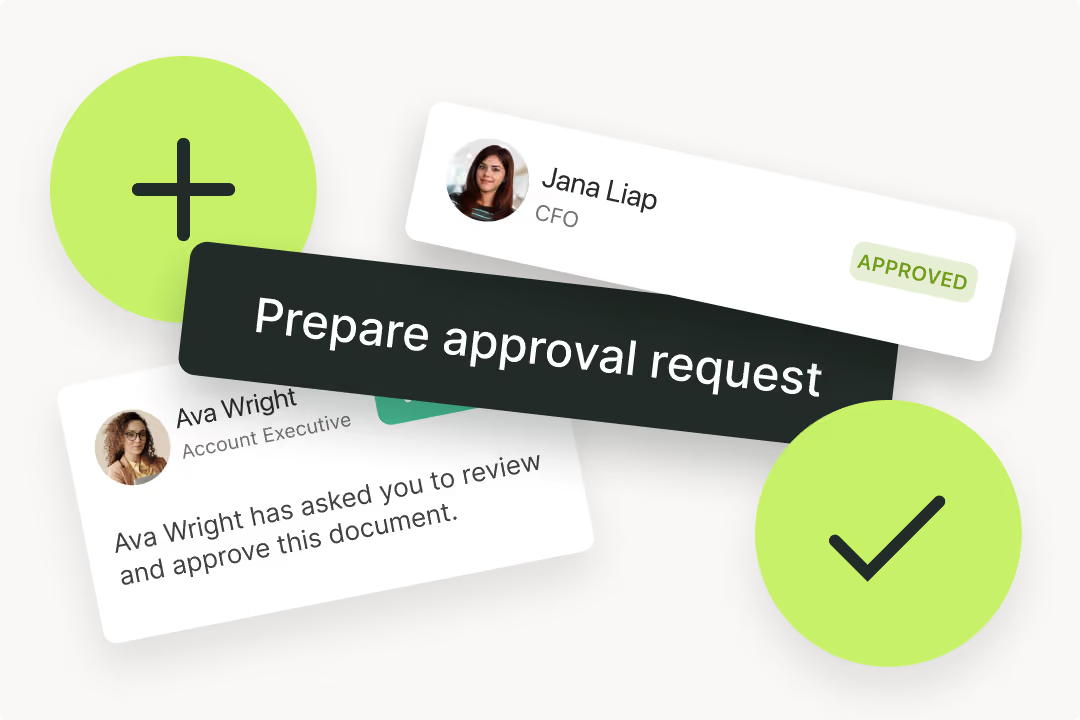
In Juro, approval workflows are fully configurable and run automatically once a contract reaches the relevant stage. Each approver is notified when their input is required. They can then review and comment directly in the contract, and approve or reject changes with just a few clicks.
These approval sequences can be set up and customized per contract, or established across your contract portfolio based on certain criteria being met. You can do the same for signing requests, including setting up signing orders for waterfall signatories.
Contract data is only useful if it is captured consistently and accurately. When different teams capture different fields in different formats, reporting becomes unreliable and data questions take longer to answer than they should.
Agreeing on a standard set of fields, such as payment terms, renewal dates, governing law, and liability caps, and making them required at the point of creation means both teams are working from the same data from day one.
Practical tip:
In Juro, these fields can be built directly into automated contract templates and intake forms as required inputs. This means that contract stakeholders are prompted to provide the information, or it can be pushed into the template automatically via an integration with a CRM like Salesforce, for example.
Finance can predict exactly which data will be available on every contract before it is even signed, and legal can be confident that the information needed for reporting and obligation tracking is always there.
Finance shouldn’t need to rely on legal to pull contract data. When either team is dependent on the other to retrieve information, it creates unnecessary delays and means critical data often arrives too late to be useful.
Both teams need live, independent access to a shared and intelligent contract repository.
Practical tip:
Juro's intelligent repository gives finance and legal searchable, reportable access to all contract data in real time.
Juro's Operator takes this even further, allowing either team to ask a plain-language question, such as "which vendor contracts renew in Q3?" or "what is our total committed spend this year?", and get an instant answer from the contract portfolio without involving anyone else.
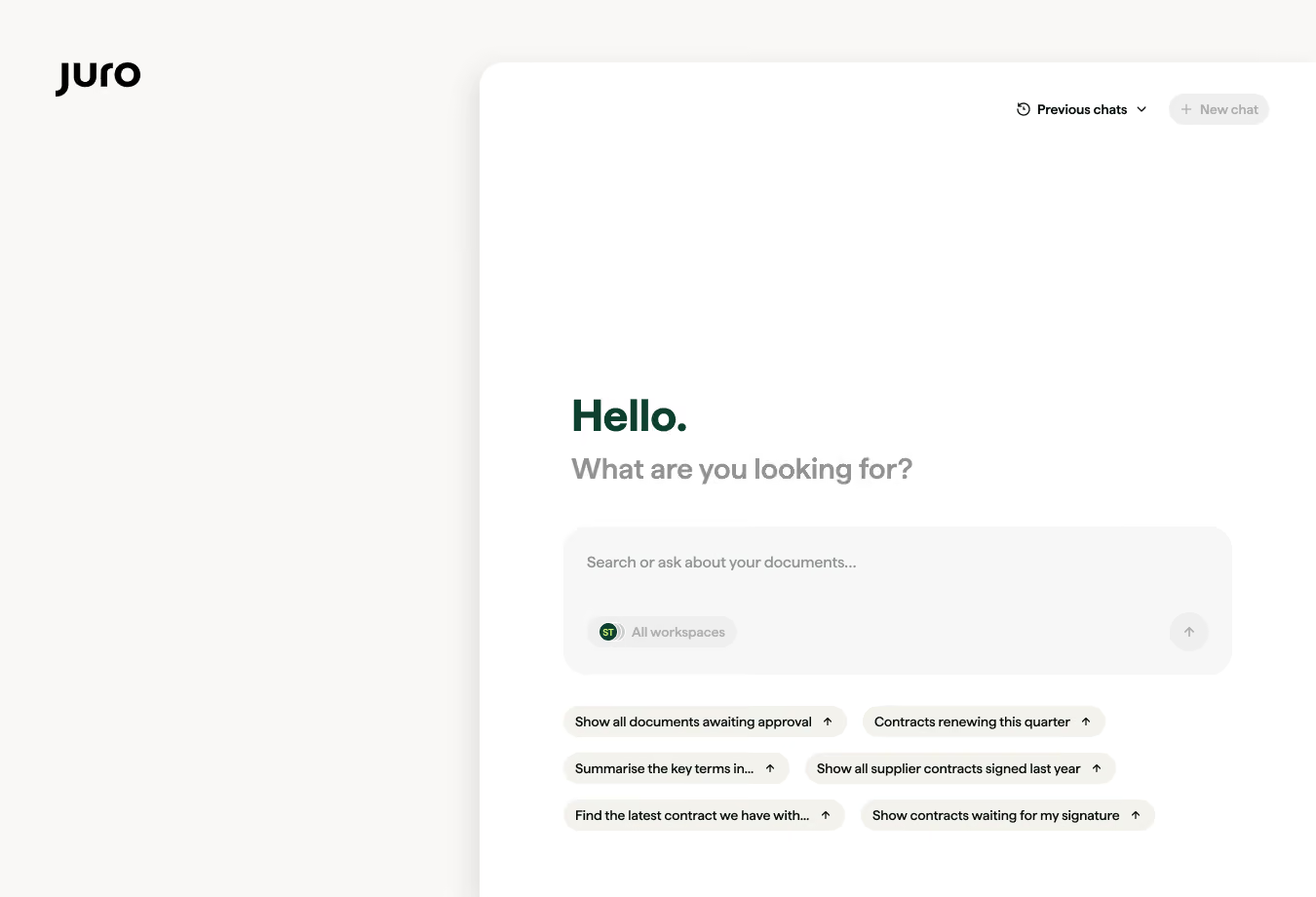
If you'd like to see Operator answer real questions against a real repository, book your personalized demo today.

Improving finance-legal collaboration is easier to justify, and to sustain, if you track the right metrics. These do not require sophisticated tooling to get started — even a basic tracking process will surface the patterns worth addressing.
These metrics are also a useful indicator of where your business sits on the contract management maturity model.
Long cycle times and a high manual intervention rate point to an early-stage process: ad hoc, fragmented, reactive. Improving approval turnaround and renewal capture rate signals a move toward an intermediate level, where some structure exists but collaboration still relies too heavily on individuals.
When data retrieval time drops to near zero and manual intervention becomes the exception, you are operating at the sophisticated end: automated workflows, AI extraction, and a shared repository that both teams can interrogate without asking each other for help.
The metrics tell you where you are, and the gap to the next stage tells you what to fix.
Finance and legal are natural allies with shared goals. But shared goals are not enough if the systems connecting them are broken. When contracts live in email threads, approvals run on memory, and renewal dates sit in a spreadsheet nobody updates, both teams are left managing risk they cannot see.
The businesses that get this right do not just agree on better processes. They build those processes into a system that runs without depending on individuals to keep it together. Contracts route to the right people automatically. Key dates surface before they become problems. Both teams can answer commercial questions from the contract portfolio in real time, without asking each other for help.
That is what Juro is built for. If your current process still runs on email and spreadsheets, that is where to start. If you are ready to see what it looks like in practice, book a demo today.
The problem is usually structural rather than cultural. Most companies manage contracts through disconnected tools — email, Word, shared drives — that were never designed for cross-functional collaboration. Without a shared process or platform, each team works from its own informal system, and obligations, approvals, and contract data fall through the gaps.
A contract lifecycle management platform gives finance and legal a shared workspace for creating, reviewing, approving, signing, and storing contracts. It also structures the data inside contracts so both teams can extract insights, like renewal dates and committed spend, without manual data entry or ad hoc requests.
A good approval workflow routes contracts to the right stakeholders in a defined sequence, with clear accountability at each stage. Legal reviews terms and risk, finance reviews commercial terms and budget, and both approve before the contract moves to signature. Approval thresholds determine which contracts need full review and which can follow a lighter path.
The most reliable approach is an intelligent contract repository with AI extraction capability. The AI pulls key dates from contracts automatically, and renewal alerts notify the relevant team members before deadlines pass. Without this, renewal tracking relies on manual spreadsheets that are difficult to maintain at scale.
Useful metrics include contract cycle time, approval turnaround time, renewal capture rate, manual intervention rate, and contract data retrieval time. Together these indicate where the process is working and where it needs fixing.
Lorem ipsum dolor sit amet, consectetur adipiscing elit. Suspendisse varius enim in eros elementum tristique. Duis cursus, mi quis viverra ornare, eros dolor interdum nulla, ut commodo diam libero vitae erat. Aenean faucibus nibh et justo cursus id rutrum lorem imperdiet. Nunc ut sem vitae risus tristique posuere.


Hello. We are Juro Online Limited (known by humans as Juro). Here's a summary of how we protect your data and respect your privacy.





Danielle Price, CFO at Duco
Danielle Price, CFO at Duco