

🇺🇸 22 Boston Wharf Rd, Boston, MA 02210
🇬🇧 2 Pear Tree Court, London EC1R 0DS
© 2026, Juro. All rights reserved.


🇺🇸 22 Boston Wharf Rd, Boston, MA 02210
🇬🇧 2 Pear Tree Court, London EC1R 0DS
© 2026, Juro. All rights reserved.

Use this Share Subscription Agreement to help you assign ownership in your company and set a concrete foundation for shareholder relations.



"It takes the sales team four clicks to generate and approve a contract in Juro. We're saving 25 minutes per contract."
Read Paddle's customer story >

Chris McFalls,
Rev Ops
"With Juro, approvals take less than two hours, and most contracts are fully signed within a day of being sent"
Read Goldin’s customer story >

Kyle Piper,
Contracts Manager
"Everyone works out of Juro - it's the key tool we use to do our job"
Read ANC’s customer story >


A Share Subscription Agreement (SSA) is a formal document that outlines the terms and conditions under which an investor agrees to purchase shares in a company.
The Share Subscription Agreement specifies the number of shares to be purchased, the price per share, and the date of the transaction, among other things.
Like most business contracts, Share Subscription Agreements become legally binding contracts once all parties agree to the terms and sign the SSA, either digitally or using a wet ink signature.
A Share Subscription Agreement works by listing the terms an investor needs to comply with to purchase shares from a company.
The rules for buying these shares can be different in each agreement, and you can find all the details in the Share Subscription Agreement itself.

But it's important to remember that when you sign a Share Subscription Agreement, it doesn't mean the company will definitely succeed.
You're not required to go through with the agreement at all. It just means you have the option to buy the shares in the future if you want to.
A Share Subscription Agreement is used when a company issues new shares to raise capital, involving the company and the new investor(s).
Meanwhile, a Share Purchase Agreement is used when an investor buys existing shares from current shareholders, with the company often not directly involved.
Still confused? Check out this guide to issuing new shares vs share transfers.
The primary purpose of a Share Subscription Agreement is to clearly define the terms and conditions of a share purchase.
By giving a detailed description of what an investor will receive from a company, SSAs help to set clear expectations and boundaries.
This can help investors and companies work effectively towards the same goals. It can also make sure everyone understands their role in the transaction, which can lead to better results and stronger relationships between investors and companies.
Various people can be involved in the creation and management of a Share Subscription Agreement.
Who gets involved usually depends on the stage of the company, though. An early-stage company probably has a more fluid and diverse mix of stakeholders when it comes to its cap table and SSAs. However, a typical SSA will usually involve the following groups:

Luckily, once the SSA has been standardized and approved, legal and executive teams can use it without needing much help from finance.
Of course, this is only true if the finance team has done a good job in setting up the cost estimates in the SSA.
To help you understand how to draft an SSA, we've created a brief checklist of what a Share Subscription Agreement typically includes. You'll also need to include the usual elements of a contract.
Share Subscription Agreements aren't just for legal teams - they're given to investors, most of whom won't have legal expertise. This means it's essential to draft SSA templates with the end user in mind.
It's good practice for SSA templates to define technical or industry-specific terms that need to be included in the contract and simplify jargon that's unnecessary. It's also important to make them plain language contracts.
This makes SSAs more understandable for your investors and ensures they fully understand what they're agreeing to.
A critical aspect to include in an SSA template is information about the shares to be purchased.
This section will typically outline the specific number of shares that the investor will purchase, the price per share, and the total investment amount.
It also needs to clearly define the expected outcome or intended deliverables of the agreement.
Every SSA template should also include a section that provides the payment terms and schedule for the investment.
This can either be a lump sum payment or a payment plan that can be calculated using a certain formula.
Either way, it's crucial that investors are aware of the payment terms and schedule, ensuring transparency and preventing misunderstandings.
Like most contract templates, a Share Subscription Agreement template should also spell out the specific terms and conditions applicable to the share purchase.
Perhaps the shares cannot be sold before a certain date, or there's a particular requirement for periodic review, for instance.
Clarifying these conditions within the SSA template is vital to ensure that investors understand exactly how and when the share purchase will be carried out.
Lots of SSA templates will also outline any warranties or guarantees provided by the company, if any.
Investors will want to know these details before agreeing to a share purchase.
An SSA template will also explain what happens in cases where the investor decides to terminate the agreement early, amongst other things.
We've identified who handles Share Subscription Agreements, but what does this process look like in more detail?
Well, it depends on how organizations choose to manage SSAs, and whether they have an SSA template in place.
For companies that operate without an SSA template, the process can be quite challenging.
It involves creating each contract, reviewing it internally, and getting the necessary approval.
Manual processes are easy to establish - it's how most businesses get started. However, when contract volumes pass 10 a month, these manual processes can quickly become painful.

Templating and automation can help businesses of every size - from SMEs using QuickBooks for contracts, to enterprises managing contracts with Salesforce.
Thankfully, it's quite uncommon for legal teams not to have a Share Subscription Agreement template today.
Most companies will have prepared templates for contracts like SSAs and stored them in shared drives for executive teams to use.
Having an SSA template stored and ready to customize eliminates the need for executive teams to wait around for legal teams to draft a new contract for every investment.
This helps reduce the time to close a deal and secure the investor's commitment before competitors get there first.

It also means that the majority of SSA terms are standardized, reducing the scope for errors and inconsistencies.
However, even if legal teams have created an SSA template, there's still considerable administrative work required on the part of executive teams to finalize them.
When these contracts are managed in Word, executive teams need to manually input all of the investor's contract data and update the investment conditions to suit their specific requirements.
Even with an SSA template in place, manually managing these contracts can be a repetitive and time-consuming process for executive teams.
Fortunately, there's a way for executive and legal teams to automate the process we just described.
Contract management software allows them to automate the contract admin tasks that they spend the most time laboring over.
For example, a contract tool like Juro can help organizations to manage Share Subscription Agreements more efficiently using the following features:
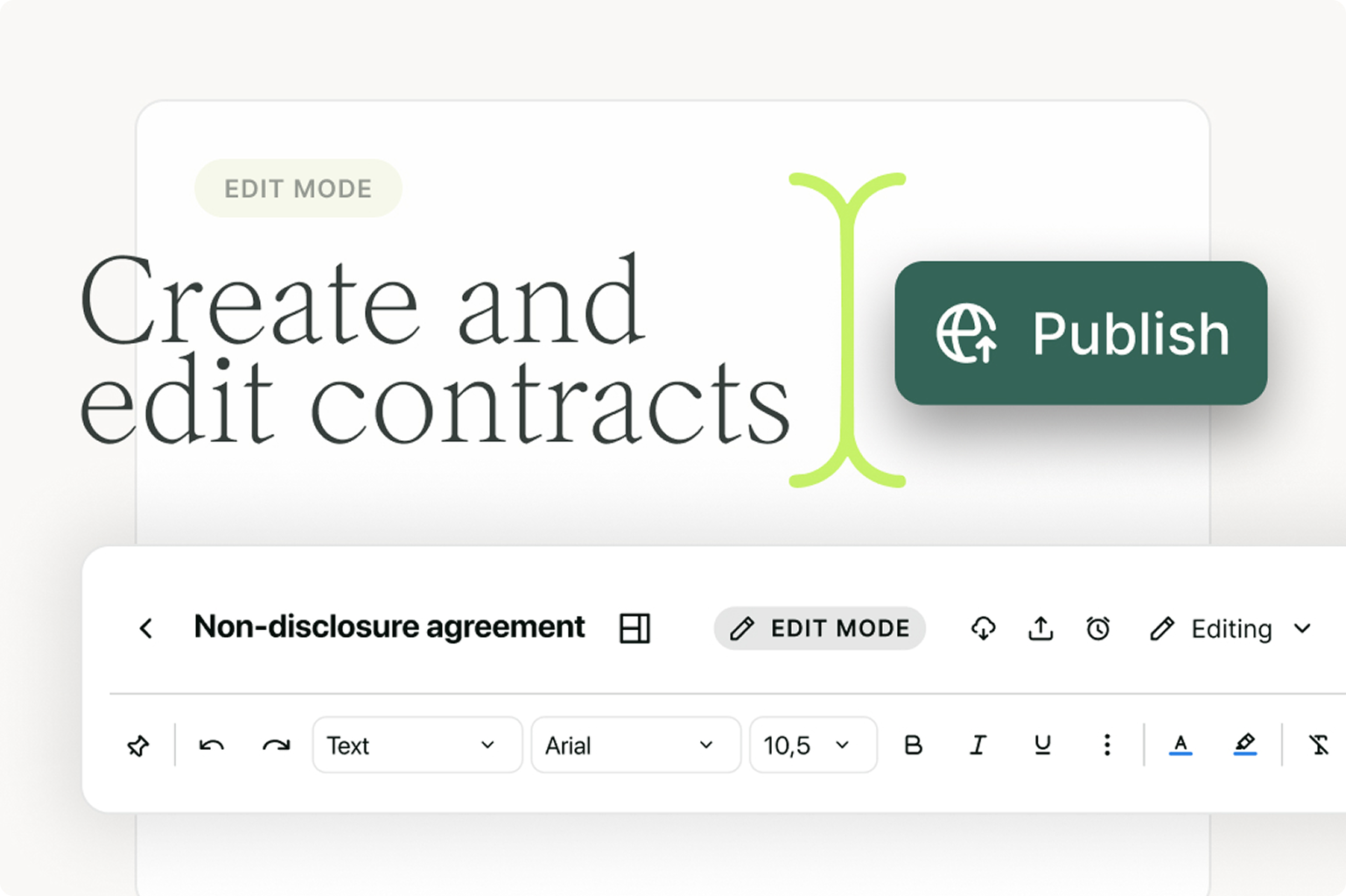
Legal teams can create flexible Share Subscription Agreement templates that are easy to populate, edit and share in Juro's rich-text editor.
The template is populated automatically in Juro. This is done by pulling your responses to a short Q&A form into the contract, or by pulling the data in from another platform.
You can even use Juro's legal AI Assistant to draft specific clauses in the contract. This means that generative AI can support you in choosing the right language, limitations and tone for your SSA.

Juro also integrates with platforms like Salesforce, HubSpot, Bullhorn and Pipedrive, enabling data from investor profiles to be pulled directly into contract fields, thereby eliminating manual data entries.
Investors can quickly sign SSAs as soon as they've read and received them using the software's native eSignature feature.
This means that you no longer need to be sat opposite an investor to get the deal done. They can sign the Share Subscription Agreement from anywhere, on any device.
SSAs can sometimes be confusing, with lots of scope for questions and negotiation. Juro allows investors to add questions and comments directly onto the contract for review.

Learn more about securing the best outcomes for your business with these contract negotiation courses.
If creating and managing Share Subscription Agreements, option agreements and shareholder resolutions has become painful for your business, it’s worth considering how contract management can help.
Juro’s AI contract collaboration platform enables your team to create, execute and manage contracts 10x faster than traditional tools. With Juro, you can:
To find out more about how Juro can speed up the process of creating, signing and managing contracts, hit the button below.
A share subscription agreement template is a ready-made contract that a company can adapt each time it issues new shares to an investor. It records the number and price of the shares, along with any conditions that apply to the investment.
Usually, yes. Without a written agreement, a friendly investment can easily turn into a dispute about how much of the company the money bought or what the investor was promised. A short SSA records the agreed price and number of shares, which also helps when you update your cap table and company records.
Often, yes. An SSA deals with the investment itself, while a shareholders’ agreement sets the ongoing rules between the owners, such as how decisions are made and what happens when someone wants to sell. Many funding rounds use both, and the SSA can make signing the shareholders’ agreement a condition of the investment.
Usually. A company’s governing documents and local company law normally set out who has to approve a new share issue, which is often the board and sometimes the existing shareholders. In many places, existing shareholders also have preemptive rights, which let them buy new shares before outsiders unless they waive those rights.
Investors usually ask the company to confirm the facts they are relying on, such as the accuracy of its accounts and the absence of undisclosed debts or disputes. The company will normally try to limit how long the warranties last and cap how much it could have to pay if one turns out to be untrue. Agreeing these limits early, and listing known issues in a disclosure schedule, avoids most arguments later.
It’s a sound starting point, but you’ll need to tailor the share details and conditions to each investment and check them against your company’s governing documents. For specific legal advice on your contract templates, consult an attorney.
Build the template in Juro once and generate each SSA from it, with the executive team filling in the investor’s details and the number of shares. When your standard terms change, you update that one template and every new agreement follows. Signed SSAs sit in one searchable place, so you can check investment dates and the warranties you gave in each round.
Yes. In Juro, Operator drafts a new SSA template using what it learns from your existing investment documents, including your drafting style and the positions you usually take on warranties and conditions. The draft reflects your risk appetite, and your legal team approves it before anyone uses it.
Answer
Juro is the #1-rated contract platform for speed of implementation — connect your CRM, automate templates, and close deals without the paperwork.
Book a personalised demo

Hello. We are Juro Online Limited (known by humans as Juro). Here's a summary of how we protect your data and respect your privacy.