
.svg)

.svg)
.svg)

🇺🇸 22 Boston Wharf Rd, Boston, MA 02210
🇬🇧 2 Pear Tree Court, London EC1R 0DS
© 2026, Juro. All rights reserved.


🇺🇸 22 Boston Wharf Rd, Boston, MA 02210
🇬🇧 2 Pear Tree Court, London EC1R 0DS
© 2026, Juro. All rights reserved.

Cloud services agreements can be complicated. This free cloud services agreement template should make it quicker and easier to onboard new clients.



"It takes the sales team four clicks to generate and approve a contract in Juro. We're saving 25 minutes per contract."
Read Paddle's customer story >
.avif)
Chris McFalls,
Rev Ops
"With Juro, approvals take less than two hours, and most contracts are fully signed within a day of being sent"
Read Goldin’s customer story >.png)
.avif)
Kyle Piper,
Contracts Manager
"Everyone works out of Juro - it's the key tool we use to do our job"
Read ANC’s customer story >


Most businesses run on a stack of cloud vendors. But the contracts underpinning those relationships are often where things go wrong.
Ambiguous SLAs, loose data handling terms, and auto-renewal clauses that lock you in before anyone notices: cloud services agreements cause problems precisely because they are so easy to overlook.
This guide covers what a cloud services agreement should contain, where disputes tend to arise, and how to manage these contracts at scale. Or download the free cloud services agreement template above and get started.
A cloud services agreement is a contract between a cloud service provider and a customer governing the terms under which the provider delivers hosted services over the internet. Those services might include software platforms, infrastructure, storage, or managed services.
Unlike a traditional software license, which grants rights to use locally installed software, a cloud services agreement covers an ongoing relationship. The provider hosts and operates the service; the customer accesses it remotely, usually on a subscription basis. That distinction matters legally, because it shifts questions of availability, data handling, and continuity onto the provider in ways a standard license does not.
Cloud services agreements are sometimes called cloud computing agreements, hosted services agreements, or software-as-a-service agreements. The terminology varies, but what matters is what the contract actually covers.
The terms overlap, and in many cases describe the same arrangement. A SaaS agreement is a type of cloud services agreement, specifically one where the cloud service being delivered is software. If you are licensing a software application hosted by a vendor, a SaaS agreement template is typically the more precise starting point.
Cloud services agreements are broader in scope. They suit arrangements involving infrastructure-as-a-service (IaaS), platform-as-a-service (PaaS), managed cloud services, or hybrid arrangements that combine software access with professional services, migration support, or infrastructure management.
Providers often pair a cloud services agreement with a standalone service level agreement (SLA) that sets out specific performance commitments: uptime targets, response times, and incident resolution windows. Keeping the SLA as a separate document makes it easier to update without reopening the main agreement.
For a broader commercial relationship with a vendor covering multiple service engagements over time, a master services agreement (MSA) may be the appropriate governing document, with individual cloud services orders sitting beneath it.
The main purpose of a cloud services agreement is to outline the rights, responsibilities, and expectations of both the cloud service provider and the client.
This agreement is designed to provide a clear roadmap for the service, helping to maintain a smooth working relationship between both parties and hopefully avoiding conflict or misaligned expectations.
It also serves to protect the interests of both parties, providing a legal framework for the provision of services.
The contents of your cloud services agreement template can vary considerably depending on the service the provider is offering and the specific needs of the client. However, most cloud services agreements will include the following:
A precise description of what the provider is delivering.
This should go beyond a product name and specify what is included, what is excluded, and what ancillary services (onboarding, training, support, professional services) are covered or charged separately. Vague scope is one of the most common sources of disputes in cloud contracts.
The terms on which the customer is permitted to access and use the service. This covers the number of authorized users, any usage restrictions, whether the customer may permit third-party access, and any prohibited uses. If the provider is granting IP rights beyond service access, those should be spelled out clearly.
The provider's commitments on uptime, performance, and support.
These are often captured in a dedicated SLA, but even where a separate SLA exists, the main agreement should specify what remedies apply when service levels are missed: credits, termination rights, or both.
A service level commitment without an enforcement mechanism is not much of a commitment.
How the provider will store, access, process, and protect customer data.
This includes security standards, what happens to customer data on termination, and where the service involves personal data, the data processing terms required under applicable privacy laws.
For many cloud services agreements, a data processing agreement (DPA) is either embedded as an exhibit or referenced as a separate document. Data portability on exit is worth addressing here too: customers should be able to retrieve their data in a usable format within a reasonable timeframe.
Subscription fees, billing cycles, any usage-based components, and what triggers additional charges.
If pricing is subject to periodic adjustment, the agreement should specify how and when the provider can increase fees and what notice is required.
More on that in our guide to contract payment terms.
The initial subscription term, the conditions under which it renews, and the notice required to prevent auto-renewal.
Auto-renewal clauses in cloud agreements are a common pain point. It is easy for a renewal to roll over unnoticed, committing the customer to another year of spend they may not want.
Juro's guide on managing auto-renew contracts covers this in more detail.
Cloud services agreements typically include a cap on the provider's financial exposure, often linked to fees paid in a preceding period.
The scope of exclusions for indirect or consequential losses is frequently negotiated.
From a customer's perspective, it is worth examining whether the cap is proportionate to the potential impact of a serious service failure or data breach.
Obligations on both parties to protect information received from the other side.
Where the service involves the customer uploading commercially sensitive data, the confidentiality terms on the provider side warrant particular attention.
The circumstances in which either party can exit the contract, including termination for material breach, insolvency, and convenience.
The agreement should address what happens to customer data after termination and any transition or offboarding obligations the provider owes.
For more information, check out our guides to contract termination and breach of contract.
The jurisdiction whose laws govern the contract and the process for resolving disputes.
For cross-border cloud services agreements, governing law and jurisdiction are not just formalities: they can materially affect the outcome of any disagreement.
Most cloud providers issue standardized agreements drafted to protect the provider. Customers who accept these terms without review are accepting assumptions about liability, data handling, and exit rights that may not reflect their actual risk exposure.
A headline uptime figure in an SLA is only as useful as the remedy attached to it. Agreements that express availability targets without specifying what the customer receives when those targets are missed give the provider little incentive to prioritize reliability.
Agreements that are silent on how customer data will be returned on termination leave customers in a weak negotiating position when the relationship ends. Specify the format, timeframe, and any costs involved.
Some cloud services agreements allow providers to increase subscription fees at renewal, sometimes with short notice periods. Customers who do not read these clauses carefully can find themselves committed to materially higher costs with limited ability to renegotiate.
The main agreement and any attached SLA should be specific about support tiers, response time targets, and escalation paths. Reasonable efforts language without defined timeframes is difficult to enforce.
A typical growth-stage company might run several dozen cloud service relationships simultaneously, each with different renewal dates, pricing structures, SLA terms, and data handling obligations.
Manual tracking is unreliable at that volume. The risk is not just missed renewals: it is the inability to answer basic questions about what you have agreed to, with whom, and on what terms.
Juro gives legal and procurement teams a single place to store, search, and monitor cloud services agreements. AI-powered extraction surfaces key data points (renewal dates, fee caps, liability limits) from both new contracts created in Juro and existing agreements uploaded to the contract repository.
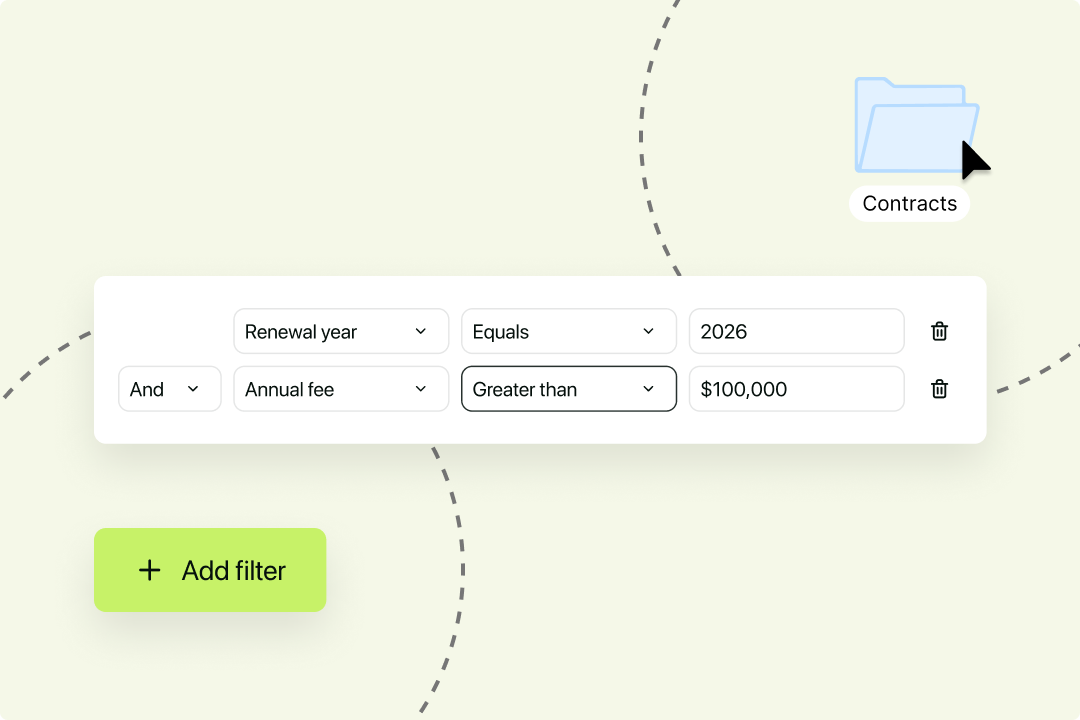
Automated reminders flag upcoming renewal windows before they close, and because contract data is structured and searchable, teams can answer questions like "how many of our cloud agreements auto-renew in Q3?" without digging through a shared drive.
For teams that want to go further, Juro's Operator brings a contract intelligence layer directly to your repository.
Instead of running keyword searches or copying contracts into a general AI tool, you can ask Operator plain-language questions about your cloud services agreements and get cited answers drawn from your actual contracts.
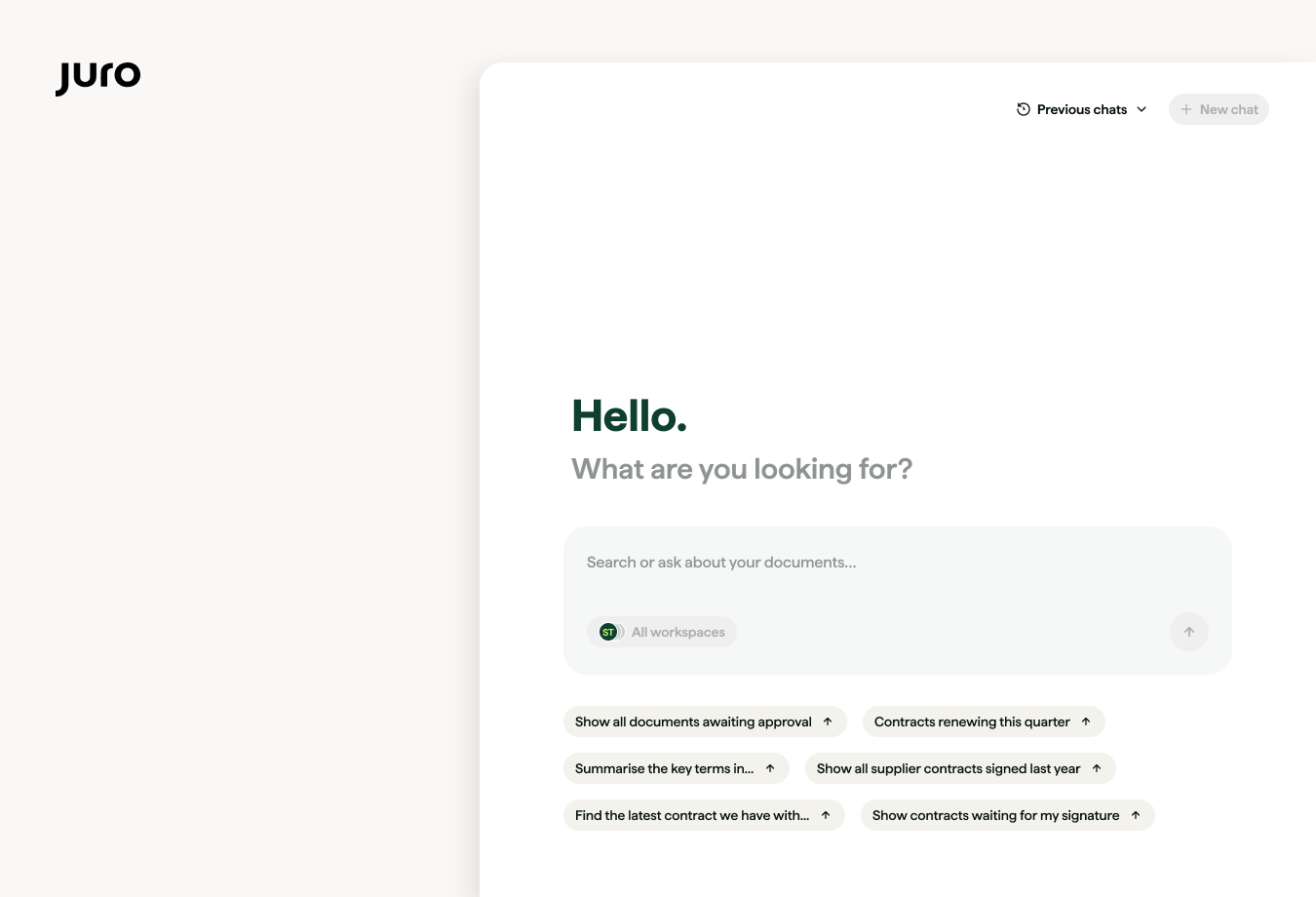
Which vendors have uncapped liability? Which agreements auto-renew in the next 90 days? What data processing obligations do we have with this provider? Operator finds the answer and shows you the source. It is the difference between having a contract repository and being able to use it.
SaleCycle's legal team, led by sole counsel Andrew Elves, used Juro to take control of a contract workflow that had previously bounced across five separate tools, saving nine working days per month across more than 650 agreements a year.
If you are managing a growing stack of cloud vendor contracts and want to see how that process could work in practice, get a demo of Juro.
Juro is the #1-rated contract platform for speed of implementation — connect your CRM, automate templates, and close deals without the paperwork.
Book a personalised demo

Hello. We are Juro Online Limited (known by humans as Juro). Here's a summary of how we protect your data and respect your privacy.