

.svg)

.svg)
.svg)

🇺🇸 22 Boston Wharf Rd, Boston, MA 02210
🇬🇧 2 Pear Tree Court, London EC1R 0DS
© 2026, Juro. All rights reserved.


🇺🇸 22 Boston Wharf Rd, Boston, MA 02210
🇬🇧 2 Pear Tree Court, London EC1R 0DS
© 2026, Juro. All rights reserved.

Download a free advertising agreement template. Learn what to include, common pitfalls, and how to manage agency and media contracts efficiently.



"It takes the sales team four clicks to generate and approve a contract in Juro. We're saving 25 minutes per contract."
Read Paddle's customer story >
.avif)
Chris McFalls,
Rev Ops
"With Juro, approvals take less than two hours, and most contracts are fully signed within a day of being sent"
Read Goldin’s customer story >.png)
.avif)
Kyle Piper,
Contracts Manager
"Everyone works out of Juro - it's the key tool we use to do our job"
Read ANC’s customer story >


Advertising relationships are easy to start and hard to exit cleanly. A brand briefs an agency, creative work begins, and somewhere between the first campaign and the third invoice, the question of who owns the assets, who approved the media spend, and who is liable for a missed deadline becomes a lot less clear than it should have been.
A well-drafted advertising agreement sets expectations before any of that happens. Download the free template above, or read on for a practical guide to what these contracts should cover and where they most commonly go wrong.
An advertising agreement is a contract between a business and an advertising agency, freelancer, or media publisher that governs the terms of a paid advertising engagement. It defines what work will be produced, where and when it will run, what it will cost, and who owns the resulting creative assets.
Advertising agreements sit within a broader family of commercial contracts that includes marketing agreements, influencer agreements, and sponsorship agreements.
The distinctions matter: a marketing agreement typically governs a broader strategic relationship, while an advertising agreement is more specifically focused on paid placements and the creative work that supports them.
Meanwhile, an insertion order is a related document used to confirm specific media bookings within an established advertising relationship.
Not all advertising engagements use the same contract structure. The type of agreement you need depends on who you are contracting with and what they are doing for you.
Agency of record agreements govern an ongoing relationship with a full-service advertising agency. These tend to be comprehensive documents covering the entire scope of the agency's mandate, including retainer fees, media buying authority, creative ownership, and performance expectations across multiple campaigns over time.
Project-based agreements cover a defined piece of work, such as a single campaign, a product launch, or a specific creative deliverable. These are narrower in scope and typically terminate when the project is complete, though they should still address IP ownership, payment milestones, and kill fees clearly.
Media placement agreements are used when buying advertising space directly from a publisher, platform, or broadcaster. These focus on placement specifications, pricing, cancellation terms, and what happens if the placement underperforms or doesn't run as contracted.
Freelance advertising agreements cover engagements with individual copywriters, art directors, designers, or other creative professionals. These share characteristics with freelance agreements more broadly but need specific attention to creative ownership and usage rights.

Identify both parties clearly and describe the services being provided with enough specificity to be actionable.
"Digital advertising support" is not a scope of services; a description of the campaigns, channels, deliverables, and formats is. Vague scope definitions are a primary source of disputes when a client expects work that the agency didn't know was included.
If the agency will be buying media on the client's behalf, the agreement needs to address the extent of that authority explicitly.
Define the total budget, any approval thresholds requiring sign-off before commitments are made, how agency commissions or fees on media spend are calculated, and who bears the cost of non-cancellable bookings if the campaign changes or ends early.
Media buying disputes are among the most financially significant in advertising relationships, so this section warrants particular care.
List the specific outputs the agency is contracted to produce, along with the deadlines for each. Include a process for reviewing and approving deliverables, the number of revision rounds included, and what happens when timelines slip.
Both parties benefit from clarity here: the client knows what to expect and when, and the agency has a defensible position if scope creep causes delays.
Advertising agreements use a range of payment models: fixed project fees, monthly retainers, time-and-materials billing, performance-based fees, or some combination.
Whatever the model, the agreement should specify the fee structure, billing frequency, payment terms, and consequences for late payment. If the engagement includes performance-based elements such as bonuses tied to results, define the metrics, measurement methodology, and reporting process precisely.
This is one of the most consequential and most often underspecified clauses in advertising agreements. The core question is whether the client owns the creative assets produced under the contract outright, or whether the agency retains ownership and licenses them to the client for specific uses.
For most clients, full assignment of IP in the finished work is the preferred outcome, but agencies sometimes resist this, particularly for work that builds on pre-existing tools, frameworks, or creative approaches they consider proprietary.
The agreement should address ownership of finished deliverables, ownership of underlying materials and work-in-progress, any limitations on how assets can be used or modified, and what happens to asset ownership if the relationship ends before the work is complete.
Third-party IP is a related consideration. If the campaign incorporates licensed music, stock imagery, or other third-party content, the agreement should specify who is responsible for securing those licenses and what usage restrictions apply.
Define who has authority to approve creative work and media plans, the timelines for providing feedback, and what happens if approvals are delayed.
Without a clear approval process, agencies can find themselves redoing work that was implicitly approved by silence, and clients can find themselves liable for placements they didn't intend to authorize.
Advertising agencies typically receive access to sensitive business information including unreleased product details, pricing strategy, and market positioning.
Include a confidentiality clause or reference a separate NDA if one is already in place. Address what happens to confidential materials if the relationship ends.
Some clients require their advertising agency not to work with direct competitors. If exclusivity is required, define the scope carefully: which competitors are covered, what constitutes a competitive relationship, and how long any restriction survives after the agreement ends.
Overly broad exclusivity provisions can make it difficult to retain quality agencies, so it is worth calibrating this to your actual competitive concerns.
Both parties should represent that they have the right to enter into the agreement and fulfill their obligations under it. The agency should warrant that work produced under the contract does not infringe third-party intellectual property.
Indemnification provisions address who bears the cost of third-party claims arising from the advertising, including claims related to false or misleading advertising, IP infringement, or regulatory violations.
Specify the duration of the agreement, renewal conditions, and the notice required to terminate.
Include a termination for convenience provision so either party can exit with appropriate notice rather than being locked in. Address what happens to work in progress, outstanding media commitments, and assets at termination.
A kill fee provision, compensating the agency for work completed on projects terminated before delivery, is common and worth addressing explicitly.
Specify how disputes will be handled, the jurisdiction governing the agreement, and whether disputes go to arbitration or litigation. For international advertising engagements with agencies or media owners in different countries, governing law is particularly important.
See Juro's guide to contractual disputes for more on how dispute resolution provisions work in practice.

Most advertising disputes were avoidable at the drafting stage. Watch out for:
1. Marketing agreement. A marketing agreement tends to cover a broader scope than an advertising agreement, potentially including PR, content, events, and brand strategy alongside paid media. An advertising agreement is specifically focused on paid placements and creative production.
2. Influencer agreement. An influencer agreement governs a different kind of paid promotion: content created and distributed by an individual with an established audience. The IP dynamics, disclosure obligations, and performance metrics differ meaningfully from those in a traditional advertising agreement.
3. Sponsorship agreement. A sponsorship agreement ties brand association to an event, property, or organization rather than to specific creative or media placements.
4. Insertion order. An insertion order is a purchase order for a specific media placement, typically issued under a pre-existing advertising agreement or media framework. It is a transactional document rather than a governing one.
Businesses that run multiple campaigns across multiple agencies and channels quickly accumulate a large, complex contract portfolio. Media commitments, deliverable deadlines, IP assignments, and renewal dates all need tracking. Without a structured approach to contract management, obligations fall through the gaps and disputes become more likely.
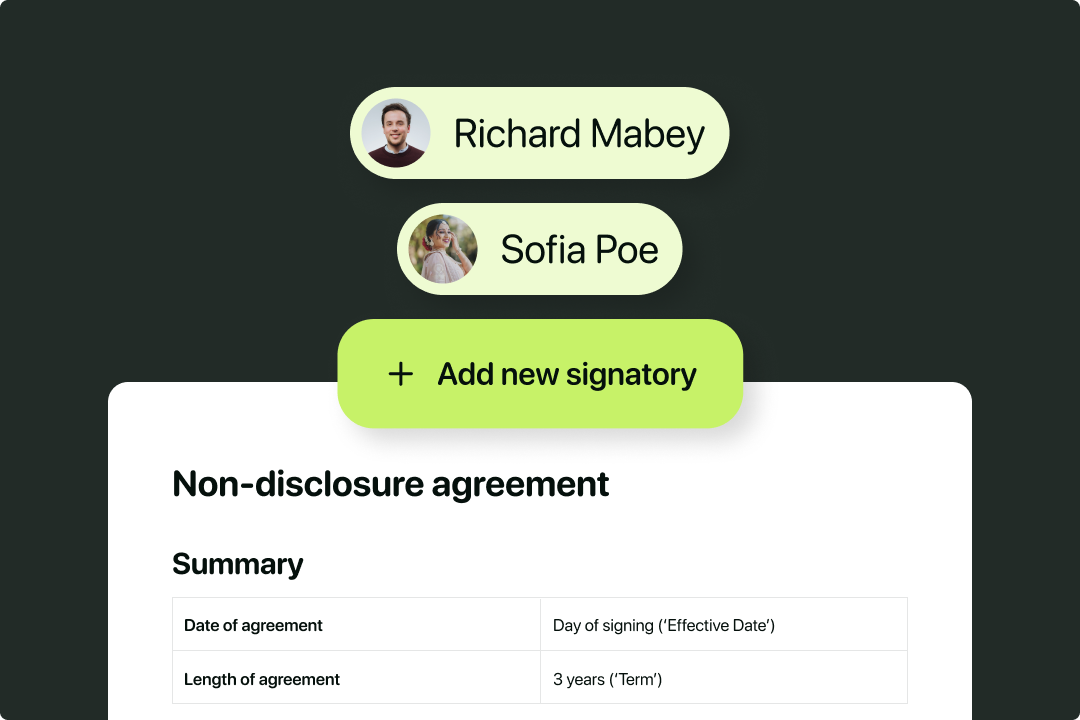
Teams using Juro build advertising agreement templates that marketing and procurement teams can use to generate contracts directly, without legal involvement on every engagement.
Key capabilities that matter for advertising contract workflows specifically:
Book a demo to see how Juro supports marketing and legal teams managing advertising contracts at volume, or join the Juro community to hear how other teams handle agency relationships and procurement workflows.
An advertising agreement template is a reusable contract a business adapts each time it hires an agency or creative to produce or place paid ads. It sets out what will be delivered and what it costs, so both sides know where they stand before any media budget is spent.
Usually, yes, if you work with the same agency or publisher regularly. An insertion order confirms one booking, such as the placement and the price, while the advertising agreement sets the terms that all those bookings run under. Keeping the main terms in the agreement means each insertion order can stay short, and you don't renegotiate payment or cancellation terms every time.
Most brands should ask to own the finished creative outright, so they can keep running and adapting it after the relationship ends. Without a written assignment, the agency or freelancer usually keeps the copyright, which often surprises clients. If the agency won't hand over its own pre-existing tools or templates, agree on a license that covers how you'll actually use the work, and confirm who pays for third-party material like music and stock images.
It works well as a starting point, but tailor it to the type of engagement, since an ongoing agency retainer needs different terms from a one-off media buy. For specific legal advice on your contract templates, consult an attorney.
Create the template in Juro once, and your marketing team can generate each new agreement from it by adding the agency's details and the campaign budget. If you change a standard term, such as the approval threshold for media spend, you change that one template and every new agreement follows. Signed contracts are kept together and are searchable, so you can find IP terms and notice periods quickly when a campaign ends.
Yes. In Juro, Operator can produce a new advertising agreement template by learning from the contracts you already use, including your drafting style and your usual positions on terms like IP ownership and kill fees. Your legal team approves the first draft before marketing uses it, and because it's built on your own contracts, it already reflects your risk appetite.
Answer
Juro is the #1-rated contract platform for speed of implementation — connect your CRM, automate templates, and close deals without the paperwork.
Book a personalised demo

Hello. We are Juro Online Limited (known by humans as Juro). Here's a summary of how we protect your data and respect your privacy.