





.svg)

.svg)
.svg)

🇺🇸 22 Boston Wharf Rd, Boston, MA 02210
🇬🇧 2 Pear Tree Court, London EC1R 0DS
© 2026, Juro. All rights reserved.


🇺🇸 22 Boston Wharf Rd, Boston, MA 02210
🇬🇧 2 Pear Tree Court, London EC1R 0DS
© 2026, Juro. All rights reserved.

Contract automation describes the use of software to generate contracts and eliminate routine contract admin work.
Contract automation enables businesses to build and execute repeatable contract workflows that require minimal manual work. Automating this work means contracts get signed faster, creating quicker routes to revenue and growth for your business.
Contract automation is useful because it eliminates unnecessary friction throughout the contract lifecycle. It achieves this by automating repetitive tasks that would otherwise be completed manually.
The best example of this is contract generation. Contract automation tools like Juro empower teams to generate contracts in seconds, and at scale - all on terms approved by legal.
Without this automation in place, legal teams would be tasked with drafting each contract individually, copying, pasting, and populating from contract templates one by one.
The result? Creating contracts becomes faster than ever before, and legal has less low-value admin landing on their desk.
Stakeholders right across the business can benefit from contract automation - not just lawyers. This is because a variety of departments are involved in managing contracts.
Take sales contracts, for example. Sales reps want to create, share and get sales agreements signed quickly to capture revenue and close their deals. Automating certain parts of the contract workflow would speed up sales cycles since automation reduces manual work and friction.
Similarly, talent teams use job offer letters, option agreements, and employment contracts to confirm new hires. Contract automation enables talent teams to create, personalize and send these contracts out for signing faster, meaning they can reduce their time to hire.
However, it’s businesses with growing contract volumes and lean legal teams that benefit most from contract automation. This is because automation enables these organizations to grow quickly despite them having limited resources.
{{quote1}}
Contract automation has the potential to solve many of the problems in-house legal teams face with their contracts today. In particular, contract automation software enables businesses to solve the following problems:
If these pain points sound familiar and you’re looking for a way to automate low-value contract admin without compromising security, control, and visibility, Juro’s collaborative contract management platform can help.
Juro enables businesses to automate contract tasks and safely free up time for high-value work. To find out more, hit the button below.

Businesses like yours can automate contracts by adopting a contract management tool that automates admin tasks throughout the contract lifecycle.
For example, you can automate contract drafting work by setting up a workflow whereby contract data is pulled into a contract template automatically, either through a Q&A workflow or from another business tool via an integration.
But there are other opportunities to automate contract admin later in the contract lifecycle. Let’s explore exactly which features are useful for contract automation and how they work now. This will explain how to automate contracts at each stage.
Automated contract templates enable teams to quickly and efficiently generate contracts in just a few clicks.
When using a contract tool like Juro, teams can initiate contracts in seconds by answering a simple Q&A workflow or pulling the contract data in from another platform via an integration. This data is automatically pulled into the contract template which eliminates the need for contract owners to draft and populate contracts manually.
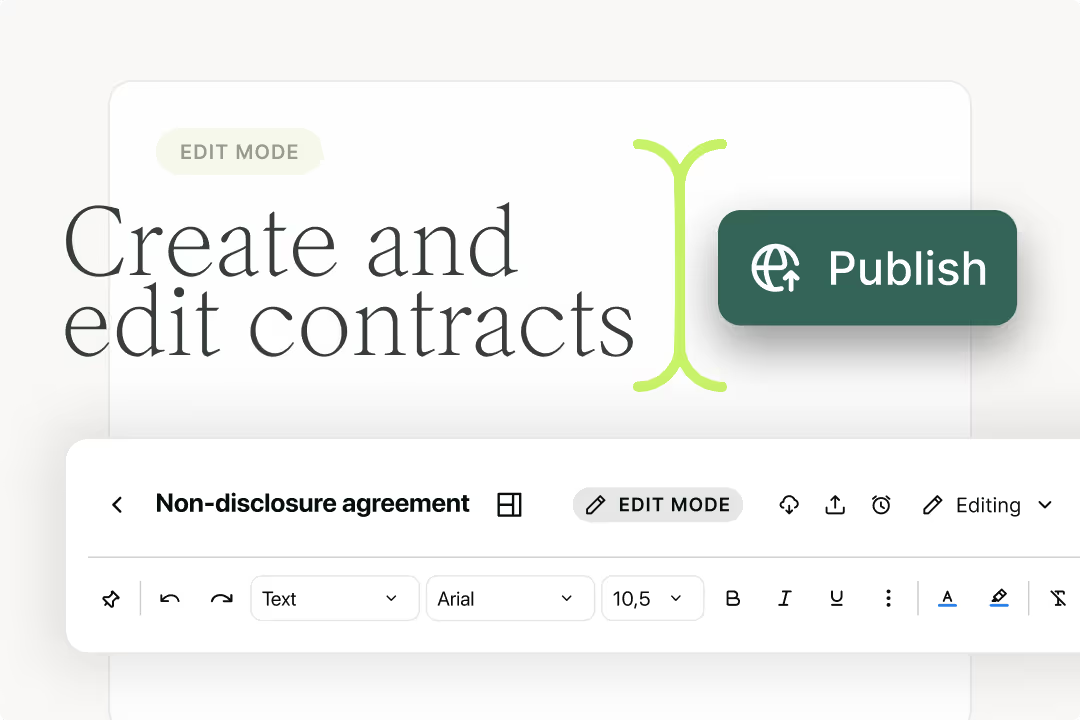
Conditional logic is another common contract automation feature. It enables teams to fully customize the terms in a contract without having to draft and edit each individual contract.
Instead, conditional logic enables teams to set rules within their contract templates that can automate the insertion or deletion of certain clauses, depending on the context of the contract.
For example, legal teams can set conditions so that certain clauses appear in the contract automatically if the contract value meets a certain threshold, and are hidden if the value is below that threshold.
This makes it easy for legal teams to retain control over which clauses a contract includes without having to track and make individual edits in these.
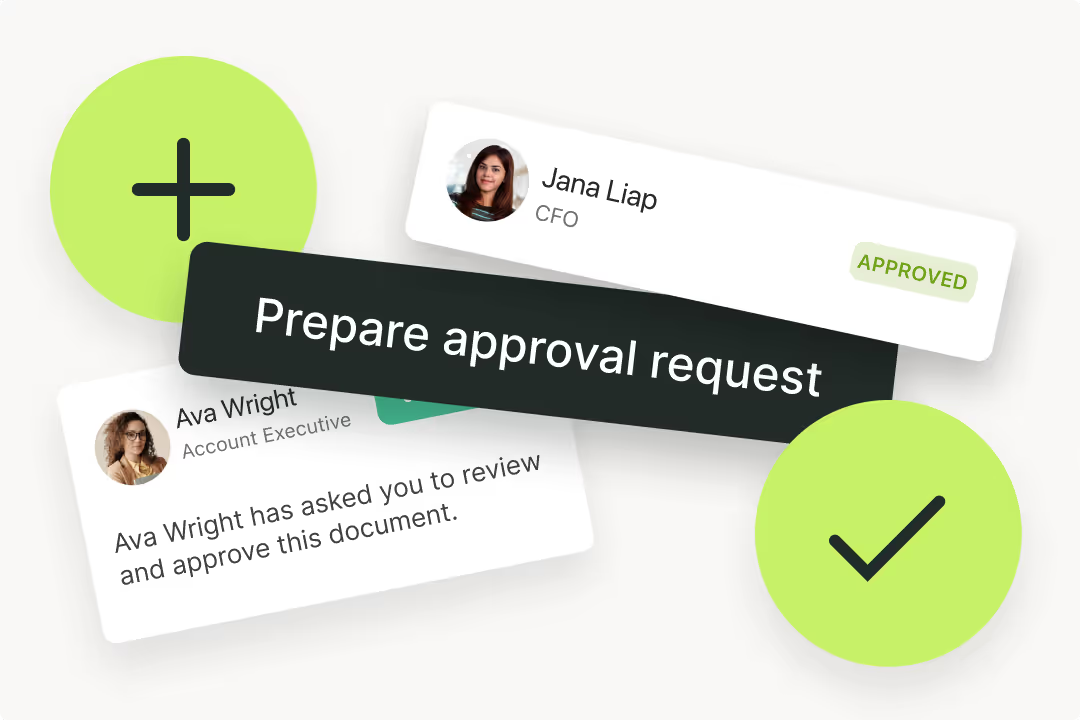
Contract automation software also enables teams to set automated approval workflows for certain contract templates, or contracts that meet specific criteria.
These approval workflows serve as a safeguard during the contract workflow since they automatically send contracts to assigned stakeholders for review and approval when they reach a certain stage.
This feature means that legal teams no longer need to oversee the entire contract lifecycle for individual contracts. Instead, they can trust that contracts will receive the right approval from the right person at the right time by automating these workflows.
Mass actions, also known as bulk actions, are another useful contract automation feature. They enable teams to perform certain actions at scale, like approving, signing and sending contracts, which isn’t possible in a manual contract workflow.
For example, Juro users can sign large volumes of contracts in just a few clicks by selecting all of the contracts in the dashboard and selecting ‘mass-sign’. This is far quicker and more efficient than adding an electronic signature to each one separately.
Contracts can be approved at scale using a similar workflow, meaning senior stakeholders spend less time completing routine contract admin and more time working on higher-value projects.
Automated contract reminders are also worthwhile if you manage lots of contracts and need visibility into expiration dates or auto-renewal deadlines.
Rather than living in Excel spreadsheets to track important contract dates, teams that use Juro can set automated contract reminders instead. These ensure that teams are notified ahead of time and are fully customizable.
Contract reminders can be used to prompt counterparties to sign contracts too. This eliminates the need for your teams to chase counterparties for signatures manually.
Contract automation tools can also pull all of your contract data into a customizable contract dashboard automatically, rather than you needing to manually capture, input and organize this contract metadata yourself.
This is only possible if your contracts are built as structured data, like they are in Juro. Otherwise, this data will need to be tagged manually, which is as painful and tedious as capturing it in a spreadsheet.
Juro’s data-rich contract repository captures all of the data in contract smartfields by default, giving teams instant access to the information in their contracts.
If you want to empower your teams to self-serve on contracts, it’s also worth looking for a contract automation solution that integrates with the platforms you use.
With the right integrations, your teams can initiate contracts in these platforms, rather than having to switch tools.
For example, Juro users can generate contracts within Salesforce and HubSpot simply by selecting ‘Create contract’ in the CRMs. This pulls the data stored in these CRM records into the contracts automatically, with no manual data entry required.
For a more detailed explanation of what this workflow looks like in practice, check out the guides below:
All of the features we just described are available in Juro, making Juro the go-to choice for businesses that want to automate contract admin and win back time for more strategic work.
In fact, Juro powers 1 million+ contracts for the world’s fastest-growing businesses, enabling legal and business teams to agree contracts up to 10x faster than traditional tools. Hear from Funnel's CLO, Victoria Sörving, on how Juro transformed contracts for the fast-growing SaaS company:
Interested in implementing contract automation in your business? Fill in the form below to speak to a specialist about how Juro would work for your team, with a personalized demo of features and use cases.
Lorem ipsum dolor sit amet, consectetur adipiscing elit. Suspendisse varius enim in eros elementum tristique. Duis cursus, mi quis viverra ornare, eros dolor interdum nulla, ut commodo diam libero vitae erat. Aenean faucibus nibh et justo cursus id rutrum lorem imperdiet. Nunc ut sem vitae risus tristique posuere.


Hello. We are Juro Online Limited (known by humans as Juro). Here's a summary of how we protect your data and respect your privacy.





Clio Anderson Garwood, Senior Legal Counsel at Paddle