




.svg)

.svg)
.svg)

🇺🇸 22 Boston Wharf Rd, Boston, MA 02210
🇬🇧 2 Pear Tree Court, London EC1R 0DS
© 2026, Juro. All rights reserved.


🇺🇸 22 Boston Wharf Rd, Boston, MA 02210
🇬🇧 2 Pear Tree Court, London EC1R 0DS
© 2026, Juro. All rights reserved.

Contract audits should be a strategic advantage. They should help you understand where revenue is leaking, where obligations are slipping, and where risk might come back to bite you. But for most in-house teams, the reality looks very different.
Instead of insights, you get inbox fishing, version-control nightmares, inconsistent term libraries, and a pressure-cooker of deadlines. Legal becomes the bottleneck. Finance gets frustrated. Leadership wants answers. And the whole process becomes a slog that everyone avoids — until something breaks.
The good news? In 2026, contract audits don’t need to be this painful. AI-native contract tools now make it possible to centralize contract data, search across thousands of agreements instantly, and validate obligations or billing terms without outsourcing or manual review.
This guide covers everything you need to know: the types of audits, when to run them, how to prepare, common pitfalls, and how tools like Juro help businesses audit faster, more accurately, and with far less effort. To see Juro's contract auditing functionality in action, hit the button below. Otherwise, read on....

A contract audit is a structured review of how well an agreement has been fulfilled, whether obligations have been met, and where risk, cost discrepancies or compliance issues might exist.
Put simply: it checks whether what was promised in the contract is actually what’s happening in practice.
Depending on your goals, a contract audit might evaluate:
These differences matter, because each type of audit uncovers different opportunities — from cost savings to compliance fixes to workflow improvements.
But what are the different types of contract audits for growing businesses, and how can you make the contract audit process more efficient in 2026? Let’s find out.
What it does: Checks whether each party is meeting their contractual obligations — operational, legal, financial or regulatory.
Why it matters: Compliance failures lead to disputes, unexpected costs, and regulatory exposure. These audits often surface inconsistencies in how teams manage, renew or deliver against contracts.
Use cases:
What it does: Reviews the clause library inside your contracts to ensure terms are correct, consistent and up-to-date.
Why it matters: Outdated or non-standard clauses lead to negotiation friction, inconsistent risk profiles, and longer cycle times.
Typical findings:
Growing teams use these audits to modernize templates, tighten risk controls, and align with new markets or regulations.
What it does: Confirms that amounts billed or paid align with contractual terms.
Why it matters: Small discrepancies compound over time. Cost audits frequently identify revenue leakage, overpayment, or unclaimed credits — often across many years.
Especially useful for:
Contract audits give you a clear view of performance, risk, cost accuracy and process quality across your agreements. In practice, teams use them to:
Since contract audits are extremely time-consuming, businesses tend to put them off. That said, there are some specific instances where contract audits are particularly common, or even compulsory, such as:
Contract audits can be performed proactively as a preventative measure or a health check, or reactively to respond to nagging concerns. This can be done in micro-audits that happen continously (e.g per contract), or. at a portfolio level annually or biannually. It’s wise to do both.
A successful contract audit follows a structured, repeatable process: scope the audit, gather your documents, extract the right data, assess performance, and document your findings. Here’s how to do it — and how Juro streamlines each step.
Before you touch a single contract, you need clarity on what you’re auditing and why.
This determines the size of the project, the stakeholders involved, and the outcomes you’re aiming to produce.
Decide on:
Juro makes it easy to define your audit scope because every contract created or stored in the platform is already structured and indexed.
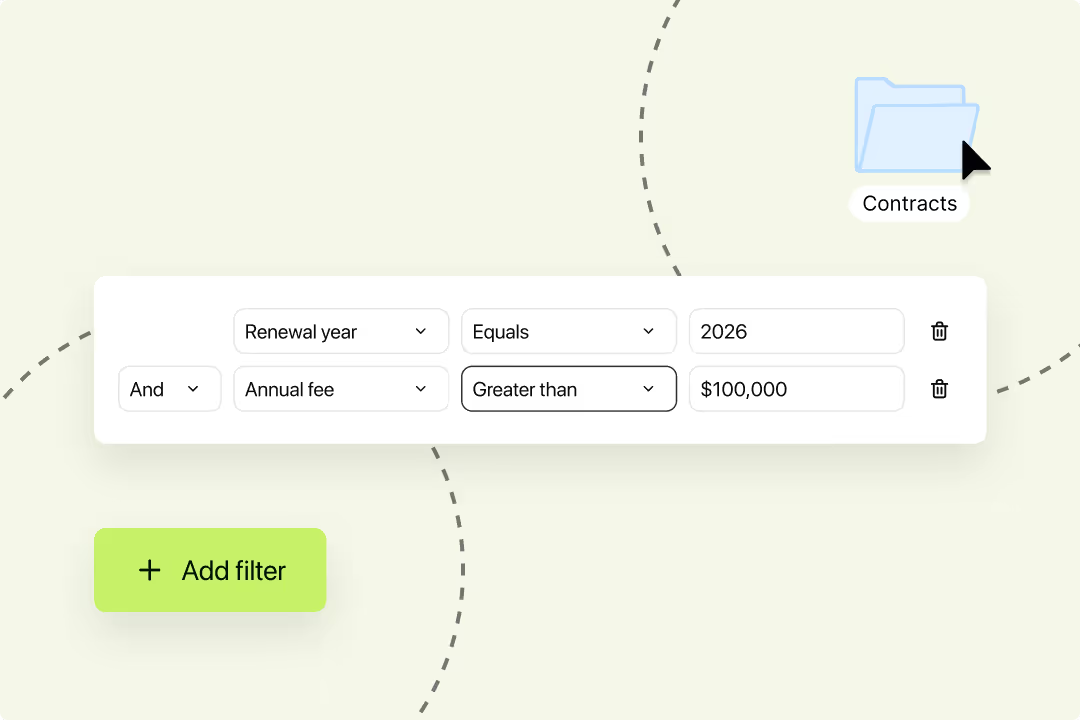
You can build your scope in seconds by applying filters across the repository — for example, narrowing down contracts by value, owner, status, template, counterparty, renewal date or any smartfield captured at creation.
This gives you an instant, reliable universe of contracts to audit, without exporting data, reconciling folders, or building spreadsheets just to understand what you’re reviewing. It’s the quickest way to move from “What’s actually in our portfolio?” to a clean, accurate audit set you can work from immediately.
The biggest barrier to audits is simply locating contracts. Companies relying on email, PDFs and shared drives waste hours trying to build a complete dataset.
In Juro, every contract — created, negotiated, approved and signed — lives in a single, organized workspace. Contract versioning is automatic, attachments are preserved, and executed copies are always available. Instead of reconciling scattered storage systems, auditors start with a complete, authoritative library of contracts, ready to review.
This is typically the most time-intensive part of the process when done manually. You need to pull out pricing terms, renewal dates, obligations, termination rights, SLAs, KPIs and other key details.
Juro contracts are built on structured data, not flat PDFs. Pricing, renewal dates, obligations, governing law, notice periods and more are captured as smartfields when contracts are drafted and signed. Auditors can surface this data instantly through table views or advanced search. There’s no need to manually read each contract or type values into Excel — the data is already clean, consistent and exportable.
Once you have the data, assess whether obligations have been met and whether operational performance aligns with the contract.
Look for:
Juro centralizes obligations automatically. Smartfields allow you to create live obligation views that show what’s upcoming, overdue or fulfilled across the entire portfolio. Automated contract reminders ensure obligations are met on time, reducing the number of avoidable issues your audit needs to address.
{{quote1}}
This stage is where the deepest insights emerge. Once you’ve surfaced the core contract data, you need to understand why issues are happening, where the risk sits, and what needs to change. Traditionally, this has meant line-by-line reading, cross-referencing clauses, and trying to map inconsistencies at scale — a process that can take days or even weeks.
Audits typically uncover patterns like:
Juro’s native ChatGPT integration reshapes this entire stage by allowing auditors to ask direct, contextual questions of their contracts — without leaving the platform. Instead of manually combing through dozens or hundreds of agreements, you can query your contract portfolio conversationally.
Your audit should end with a clear, prioritised output that stakeholders can act on. This includes risk summaries, cost insights, compliance issues, template improvements and recommended process changes.
Because Juro keeps all metadata structured and centralized, continous reporting becomes frictionless. You can export filtered contract tables, contract summaries or clause reports directly, or share live dashboards with finance, sales, ops or leadership. There’s no manual consolidation or messy spreadsheets — just clean, shareable insights.
If you’re ready to move away from slow, manual audits, Juro is the fastest way to modernize how your business reviews its contracts.
Juro gives you a single, structured workspace for every agreement, so auditors don’t waste time searching across inboxes, shared drives or outdated PDFs. Powerful search and filtering let you surface the exact contracts, clauses or values you need in seconds.
Because contracts in Juro are built on structured data, you can query pricing, renewal dates, obligations, notice periods and more without reading line by line — no separate AI review tool required. Smartfields capture key terms automatically, and obligation reminders help you stay compliant year-round.
So, if you want contract audits that take hours instead of months, with cleaner data, fewer blind spots and far less manual effort, fill in the form below.
Lorem ipsum dolor sit amet, consectetur adipiscing elit. Suspendisse varius enim in eros elementum tristique. Duis cursus, mi quis viverra ornare, eros dolor interdum nulla, ut commodo diam libero vitae erat. Aenean faucibus nibh et justo cursus id rutrum lorem imperdiet. Nunc ut sem vitae risus tristique posuere.


Hello. We are Juro Online Limited (known by humans as Juro). Here's a summary of how we protect your data and respect your privacy.




.avif)
Okechukwu Eke, General Counsel at Moniepoint